DailyGS2medium

Marital Rape: SC Says Legislature Must Make It Punishable

Supreme Court says Parliament must decide on criminalising marital rape, as IPC/BNS retain a marital exception despite constitutional principles of dignity, equality, and bodily autonomy. Key issues: consent, Article 14 and 21, legislative vs judicial domain.

10 Sept 2026 2 min read 0 views
Marital Rape: SC Says Legislature Must Make It Punishable

Quick Revision

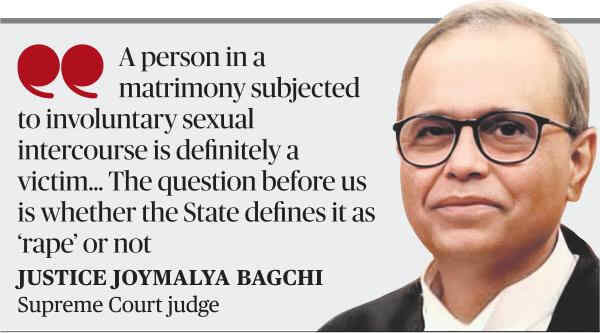
Why in news: The Supreme Court has observed that the responsibility to make marital rape punishable as a criminal offence lies primarily with the legislature. The Court noted that although married women have individual autonomy and protection from sexual abuse, the existing IPC Section 375 and BNS Section 63 retain an exception for sexual acts by a husband with his wife.

Background

  • IPC Section 375, Exception 2: Traditionally excluded non-consensual sexual intercourse by a husband with his wife from the definition of rape, subject to the statutory age condition.

  • BNS Section 63: Repealed the IPC but retained the marital rape exception, with the wife's age threshold raised to 18 years.

  • The Karnataka High Court (2022) allowed a husband to face rape charges for allegedly forcing sexual intercourse on his wife.

  • The Supreme Court is examining whether courts can permit such prosecution when Parliament has expressly created an exemption.

  • The Justice J.S. Verma Committee (2013) had recommended removing the marital rape exception.

Key Issues

  • Consent and bodily autonomy: Marriage does not automatically imply permanent sexual consent.

  • Legislative domain: Criminal offences are primarily defined by Parliament through penal legislation.

  • Judicial review: Courts can examine whether the marital rape exception violates constitutional rights.

  • Article 14: Raises questions of equality before the law and differential treatment of married and unmarried women.

  • Article 21: Sexual autonomy, dignity and bodily integrity form part of the right to life and personal liberty.

  • Protection of marriage vs individual rights: The debate involves balancing marital privacy with women's dignity and autonomy.

Challenges

  • Conflict between existing law and constitutional values: The law retains an exception while constitutional jurisprudence increasingly emphasises dignity and autonomy.

  • Fear of misuse: Opponents argue that criminalisation could lead to false or difficult-to-prove allegations.

  • Proof and investigation: Sexual offences within marriage can be particularly difficult to establish because of the private nature of the relationship.

  • Institutional question: Courts must avoid effectively creating a new criminal offence while interpreting existing legislation.

  • Social stigma: Victims may face family and societal pressure against reporting abuse.


Way Forward

  • Parliament should undertake a comprehensive review of the marital rape exception.

  • Any reform should clearly define consent within marriage and provide appropriate safeguards against false complaints.

  • Strengthen evidence-gathering, investigation and victim-support mechanisms.

  • Ensure protection against domestic and sexual violence without undermining due process.

  • Judicial interpretation should continue to uphold dignity, bodily autonomy and equality, while respecting separation of powers.

Conclusion

The marital rape debate represents a conflict between an old statutory exception and evolving constitutional principles of dignity, equality and individual autonomy. The Supreme Court's present question is not whether forced sex within marriage is harmful, but whether courts can criminalise it as rape when Parliament has expressly retained an exemption. A clear legislative resolution is therefore essential.

UPSC Prelims Facts

Term: Alleged Tax Evasion through Bogus Political Parties (RUPPs)

Meaning: The Congress party's demand for a Joint Parliamentary Committee (JPC) probe into alleged tax evasion of over ₹10,000 crore through 3,260 Registered Unrecognised Political Parties (RUPPs), which are accused of being used to convert unaccounted money into legitimate political donations via round-tripping and exploit tax exemptions meant for genuine political activity.

Related: Registered Unrecognised Political Parties (RUPPs), political funding, tax evasion, round-tripping, money laundering, JPC, Election Commission of India, Section 29A (RPA 1951), Income Tax Act, Article 324, electoral integrity, transparency, donor verification. 

Core theme: Alleged misuse of Registered Unrecognised Political Parties to convert unaccounted money into legitimate donations through tax exemptions demands stronger transparency, inter-agency coordination, and independent investigation to protect electoral integrity and political finance accountability. 


Prelims angle

Focus on key facts, terms and institutions mentioned above.

Mains angle

Link to relevant GS themes and frame analytical points.

Syllabus: Indian Polity, Polity

Download notes

Daily Current Affairs - 10 September 2026

Free download

Test yourself

Daily Current Affairs Quiz - 10 September 2026

Practice the related MCQs now.

Attempt the quiz
Free resource

Get free monthly Current Affairs PDF

Join thousands of aspirants. We'll send the compilation to your WhatsApp.

No spam. Unsubscribe anytime.

More from Current Affairs

Drug-Free by 2029 Roadmap: Amit Shah
Daily Important
SecurityPrelims + Mains

Drug-Free by 2029 Roadmap: Amit Shah

The Minister of Home Affairs unveils roadmap for creating a drug-free India by 2029, covering the full gamut of the drug trade-production, smuggling, consumption, and funding. The approach includes enforcement, rehabilitation, and alternative livelihoods. Challenges include cross-border smuggling, the dark web, and treatment of addicts. The approach involves intelligence gathering, financial targeting, prevention, and technology.

7 Sept 2026 3 min
Implementing ₹24,000-crore scheme to modernise police, Centre tells Supreme Court
Daily Important
Polity & GovernancePrelims + Mains

Implementing ₹24,000-crore scheme to modernise police, Centre tells Supreme Court

Centre announces ₹24,000-crore Police Modernisation Mission over five years for State and Central police forces. Supreme Court was informed amid concerns over non-functional CCTV cameras. Challenges: fund underutilisation, maintenance gaps, manpower shortage, and lack of police reforms. Success depends on outcome-based funding, lifecycle maintenance, reforms, and citizen-centric accountability.

4 Sept 2026 3 min
Constitutional Fault Lines in the FCRA Bill Explained
Daily Important
Polity & GovernancePrelims + Mains

Constitutional Fault Lines in the FCRA Bill Explained

The FCRA Amendment Bill 2026 empowers the government to seize and dispose of the properties of NGOs once their registration is cancelled, and thus there are constitutional issues with executive excesses, proportionality, and institutional independence. The need for balance between national security and individual rights is vital. Way forward: clear guidelines, safeguards, timely action, and judicial supervision.

3 Sept 2026 3 min