Background
Police is a State subject under Entry 2 of the State List. However, the Centre supports States through financial assistance and centrally sponsored initiatives for police modernisation.
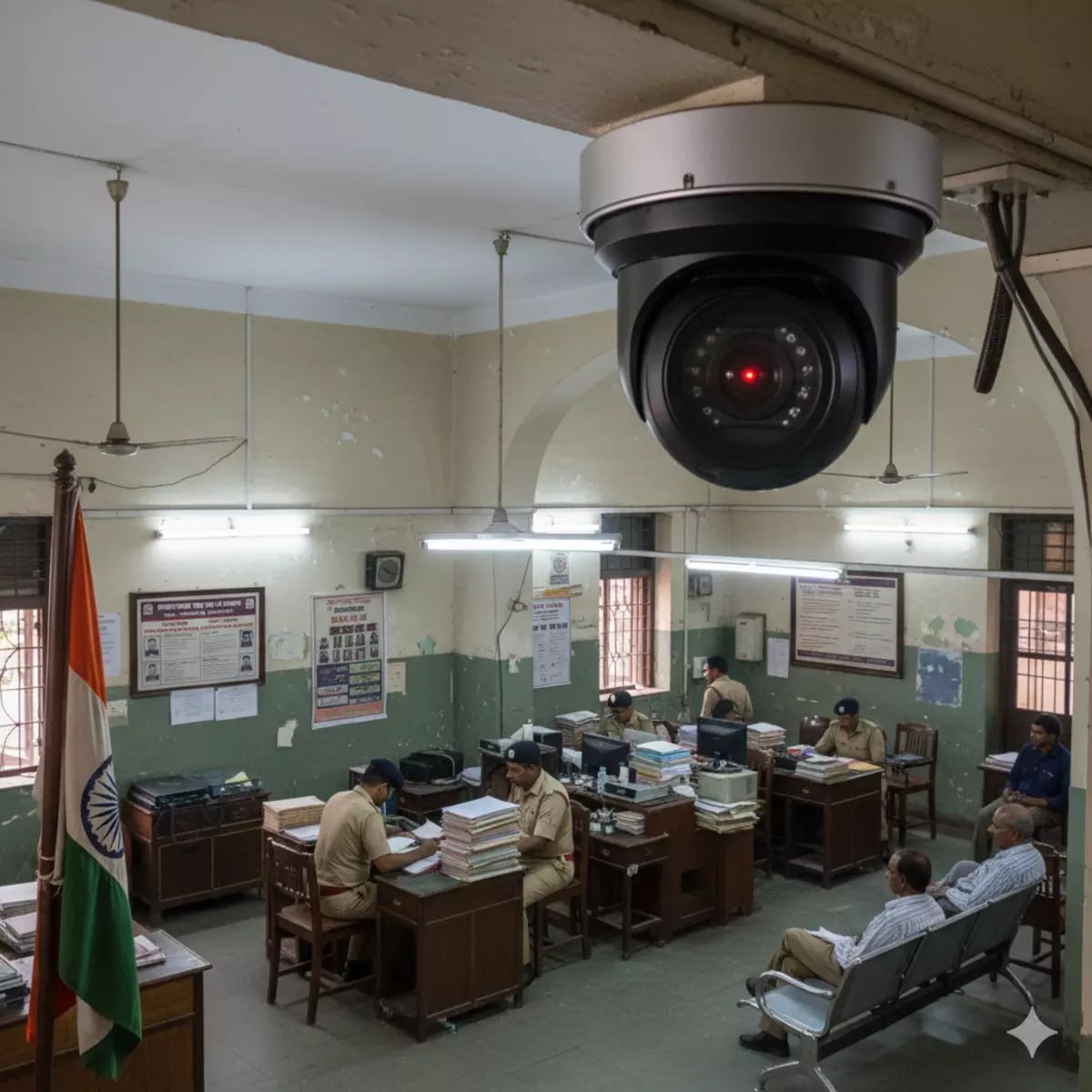
The 2021 Paramvir Singh Saini v. Baljit Singh judgment mandated CCTV cameras at specified locations in police stations, including lock-ups and interrogation areas.
These cameras were required to have night vision and audio recording, with footage preserved for a prescribed period.
State and district-level oversight committees were also envisaged to monitor procurement, maintenance and functioning.
The present Supreme Court proceedings arose after a media report highlighted non-functional CCTV cameras at police stations in Udaipur.
Thus, the issue has shifted from merely installing technology to ensuring that it remains functional and contributes to accountability.
What is the Police Modernisation Mission?
Its form: It is an umbrella scheme, meaning several police modernisation components are funded through a single mission rather than as separate schemes.
Its size and horizon: The outlay is Rs 24,000 crore, to be spent over five years.
Who it covers: It targets the internal security capabilities of both State police forces and the Central Armed Police Forces.
Its stated route: The capability gain is to come through greater use of technology, which is the only delivery mechanism named in the submission.
Key Features of the Mission
Umbrella approach: Multiple police-modernisation components are brought under a single mission.
₹24,000-crore outlay: The expenditure is spread over five years.
Broad coverage: It seeks to strengthen the internal-security capabilities of both State police forces and Central Armed Police Forces.
Technology-driven modernisation: Greater use of technology is the principal mechanism identified for improving capabilities.
Challenges
Underutilisation of funds: States may fail to utilise modernisation grants due to delays in matching contributions and pending utilisation certificates.
Technology without police reforms: Modern equipment cannot address structural issues such as political interference, weak accountability, insecure tenure and poor implementation of the Prakash Singh reforms.
Maintenance deficit: CCTV cameras, CCTNS terminals and other systems may become non-functional due to inadequate AMC, spare parts, power backup and technical support.
Manpower shortage: Lack of sufficient and trained personnel limits the effective use of modern technology.
Digital and surveillance risks: Greater use of cameras, facial recognition and databases can increase surveillance and raise concerns regarding privacy, data protection and misuse.
Centre–State coordination: Since police is a State subject, implementation depends heavily on State governments, creating differences in capacity and compliance across States.
Way Forward
Outcome-based funding: Release funds in tranches based on measurable outcomes such as equipment installed, operational and regularly maintained.
Lifecycle maintenance: Include multi-year funding for AMC, spare parts, power backup and software upgrades along with capital expenditure.
Technology + manpower: Combine modernisation with recruitment, training and capacity building so that technology is effectively utilised.
Police reforms: Link a portion of central assistance to implementation of Prakash Singh directions, including fixed tenure and institutional accountability.
Independent oversight: Strengthen independent monitoring of CCTV access, footage retention and surveillance systems to prevent misuse.
Centre–State coordination: Establish clear common standards while allowing States flexibility according to their local policing requirements.
Citizen-centric approach: Ensure that modernisation improves transparency, human-rights protection, response time and public trust, rather than focusing only on technological capability.
Conclusion
The Police Modernisation Mission worth ₹24,000 crore is a chance for India to make its policing structure more advanced. Nevertheless, the mission needs to be more than a technology purchase. It will succeed based on maintenance, sufficient staffing, and police reforms.


