Background
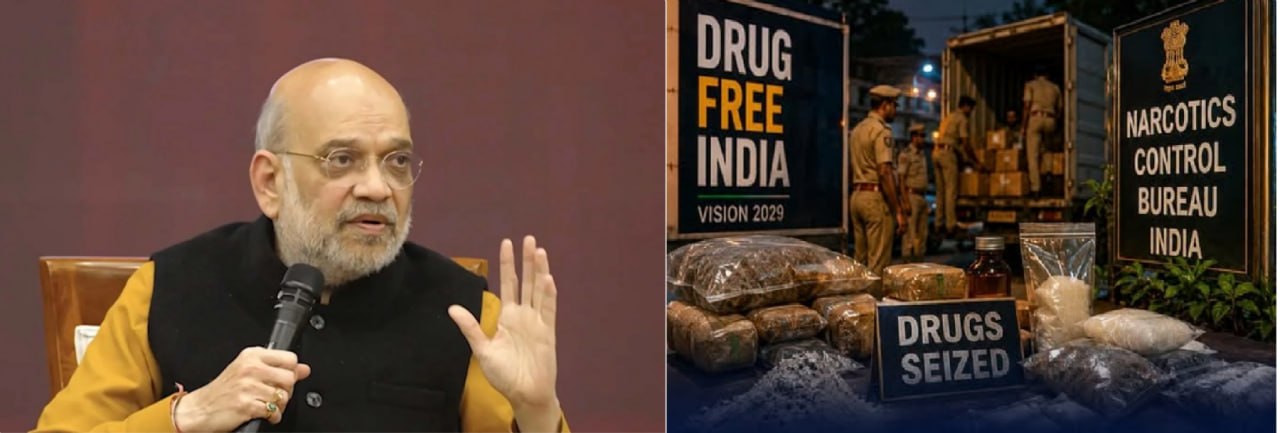
India faces challenges from both domestic drug abuse and international narcotics trafficking because of its geographical location between major drug-producing regions.
To strengthen coordination, the government created the National Coordination Committee for Countering Drug Trafficking (NCORD) in 2019. It operates through four levels-Central, State, and district-to coordinate action against narcotics.
Other measures include:
Anti-Narcotics Task Forces (ANTFs) in all States and Union Territories.
A Joint Coordination Committee to coordinate Central and State agencies against major drug networks.
Strengthening of the Narcotics Control Bureau (NCB) through greater manpower, territorial presence and operational capacity.
Linking anti-drug efforts with awareness, treatment, rehabilitation and livelihood opportunities.
Introduction of the MANAS helpline (1933) to assist people affected by drug addiction.
Key Features
Whole-of-government approach
The government is attempting to coordinate the Centre, States, district administrations and police forces rather than treating narcotics control as the responsibility of one agency.
Targeting the entire narcotics chain
The strategy seeks to disrupt: production → trafficking → distribution → consumption → illicit financing.
Particular attention is being given to major drug networks and their international connections.
Stronger enforcement
The government is strengthening the NCB and State-level Anti-Narcotics Task Forces to improve intelligence gathering, investigation and enforcement.
Focus on rehabilitation
The approach goes beyond criminal enforcement by incorporating:
Awareness
De-addiction treatment
Rehabilitation
Social reintegration
Livelihood opportunities
This recognises addiction as both a law-and-order and public-health challenge.
Challenges
Cross-border trafficking
India's location near major drug-producing regions makes controlling international trafficking difficult.
Dark-net and digital networks
Drug traffickers increasingly exploit encrypted communication, online platforms and sophisticated financial channels, making traditional policing less effective.
Drug financing
Simply arresting traffickers may not dismantle networks unless their financial infrastructure and assets are also targeted.
Addiction and rehabilitation
Supply reduction alone cannot eliminate demand. People suffering from addiction require accessible and affordable treatment and long-term rehabilitation.
Centre-State coordination
Narcotics enforcement involves multiple agencies and governments. Effective information sharing and coordinated investigation are therefore essential.
Measuring the 2029 goal
A credible roadmap needs measurable indicators—such as reductions in trafficking, availability, addiction rates, repeat offences and successful rehabilitation-rather than relying only on seizure and arrest numbers.
Way Forward
Strengthen intelligence sharing among NCB, State police, customs, financial-intelligence agencies and international partners.
Target the finances of drug syndicates through money-trail investigations, asset confiscation and action against illicit financial networks.
Improve border surveillance along vulnerable land and maritime routes.
Strengthen treatment and rehabilitation, particularly at the district level.
Focus on prevention among youth through schools, colleges, communities and digital awareness campaigns.
Use technology and data analytics to identify trafficking patterns, darknet activity and financial networks.
Develop measurable annual targets towards 2029 so that progress can be independently assessed.
Strengthen international cooperation because major narcotics networks often operate across national boundaries.
Conclusion
The goal for India to become a drug-free nation by 2029 marks a step forward in the country's approach of the country away from a policy based only on enforcement to one that integrates prevention, enforcement, economic disruption, treatment, and rehabilitation. The true test of the approach will be its execution. A winning strategy should involve reducing the supply of the drugs, disrupting organised drug networks, reducing the demand, and rehabilitating the people.


