DailyGS3medium

Why Are Bank Unions Going on Strike?

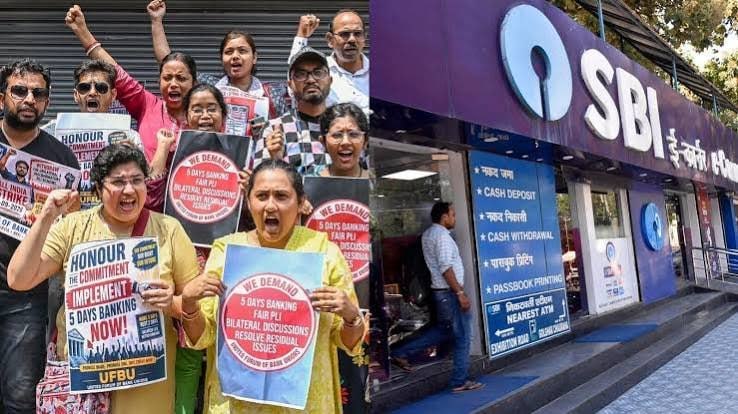
The union for banks has issued a countrywide strike that demands a banking week of five days, revision of the Performance Linked Incentive policy and the negotiation of unresolved matters. The strike highlights the conflict between collective bargaining and the power of the government in determining bank holidays. It could cause disruptions in branch operations, particularly in rural settings.

28 Sept 2026 3 min read 12 views
Why Are Bank Unions Going on Strike?

Quick Revision

Why in news: The United Forum of Bank Unions (UFBU), representing seven bank unions, has called a three-day nationwide strike from 28–30 September 2026. The unions have also threatened an indefinite strike from 26 October 2026 if their demands are not addressed. The principal demand is implementation of a five-day banking week, with all Saturdays declared bank holidays. The Indian Banks’ Association (IBA) has already accepted the demand and forwarded the proposal to the government for approval. Other demands relate to the Performance Linked Incentive (PLI) scheme, bilateral negotiations and pending issues from earlier wage settlements.

Background

  • At present, bank branches generally remain closed on the second and fourth Saturdays, while other Saturdays are working days.

  • The unions want banks to operate from Monday to Friday, with appropriate extension of weekday working hours to ensure that customer service hours are not reduced.

  • Bank working hours and wages are largely determined through bipartite settlements between bank management and employee unions.

  • However, declaration of a bank holiday requires government action under the Negotiable Instruments Act, 1881.

  • Thus, although the employers' representative body has accepted the five-day week proposal, final implementation requires government approval.

Four Major Demands

Five-day banking week

  • Make all Saturdays bank holidays.

Revision of Performance Linked Incentive

  • Unions oppose the existing revised structure because it primarily covers senior grades.

Bilateral negotiations on the incentive scheme

  • Unions want the scheme to be settled through negotiations rather than unilateral government orders.

Settlement of pending issues

  • Resolve outstanding matters from previous wage settlements.

Performance Linked Incentive Scheme

  • The Performance Linked Incentive (PLI) was introduced under the 2020 wage settlement.

  • It links employee incentives to the performance of the respective bank.

  • The revised government scheme covers Grade 4A officers and above, leading to objections from officers' associations and concerns about unequal coverage across employees.

Impact of the Strike

  • The timing is significant because 30 September is the half-yearly closing date for banks.

Public-sector bank branches may face disruption in:

  • Cash deposits and withdrawals

  • Cheque clearing

  • Account-related services

  • Other branch-level banking operations

  • UPI, internet banking and ATMs are expected to continue functioning, although cash availability could become an issue if ATMs are not adequately replenished.

  • Private-sector bank branches are expected to remain largely operational.

  • Public-sector and regional rural banks opened on a Sunday to reduce the impact of the extended closure period.

  • The Finance Ministry has advised banks to ensure adequate ATM cash availability and encouraged customers to complete time-sensitive transactions in advance.

Challenges

Settlement–implementation gap

  • The employers may agree to changes in working arrangements, but the government has the authority to notify banking holidays.

Unequal incentive coverage

  • Restricting the revised incentive scheme to higher grades can create differences among employees and generate opposition from other categories.

 Increasing digitalisation

  • The growing use of UPI, internet banking and ATMs may reduce the direct impact of branch closures on digitally connected customers.

Rural and cash-dependent customers

  • Customers dependent on physical branches and cash services, particularly in rural areas and through regional rural banks, may experience greater disruption.

Coordination problem

  • A banking holiday affects customers, businesses, clearing systems and financial markets, making coordination among banks, unions and government important.

Way Forward

  • Set a clear timeline: The government should establish a time-bound process for deciding the five-day banking proposal.

  • Include the competent authority: Government authorities responsible for notifying bank holidays should be involved in negotiations at an early stage.

  • Make incentives broad-based: The PLI framework could be designed to provide transparent and performance-based incentives across appropriate employee categories.

  • Strengthen bipartite dialogue: Outstanding wage and service-related issues should be resolved through structured negotiations.

  • Essential-services protocol: Banks and unions could establish arrangements for critical functions such as cash management, clearing and essential customer services during strikes.

  • Protect rural access: Contingency arrangements should specifically address customers who depend heavily on physical banking facilities.

Conclusion

The bank strike highlights a gap between collective bargaining and statutory authority: while bank managements may agree to changes in working arrangements, the declaration of bank holidays requires government action. The dispute therefore involves not only wage and service conditions but also the institutional relationship between bank unions, bank managements and the government.
UPSC Prelims Facts

Term: Bank Unions' Strike (September 2026)

Meaning: A three-day nationwide strike called by the United Forum of Bank Unions (UFBU), representing seven bank unions, from 28–30 September 2026, with a threatened indefinite strike from 26 October 2026, primarily demanding a five-day banking week with all Saturdays as bank holidays, alongside revisions to the Performance Linked Incentive (PLI) scheme, bilateral negotiations and settlement of pending wage issues.

Related: United Forum of Bank Unions (UFBU), Indian Banks' Association (IBA), Negotiable Instruments Act 1881, 2020 wage settlement, PLI scheme, Grade 4A officers, half-yearly closing (30 September), UPI/NEFT/ATMs, regional rural banks, Finance Ministry, bipartite settlements.

Core Themes: Collective bargaining vs. statutory authority (government must notify bank holidays); five-day banking week and working-hour extension; unequal PLI coverage favouring senior grades; settlement–implementation gap; impact on cash, cheque clearing and branch services, especially for rural and cash-dependent customers; resilience of digital banking; challenges of coordination among banks, unions and government; way forward through clear timelines, early involvement of competent authority, broad-based incentives, strengthened bipartite dialogue, essential-services protocols and protection of rural access.

Prelims angle

Focus on key facts, terms and institutions mentioned above.

Mains angle

Link to relevant GS themes and frame analytical points.

Syllabus: Economy, Indian Economy

Download notes

Daily Current Affairs - 28 September

Free download · 6 downloads

Test yourself

Daily Current Affairs Quiz - 28 September 2026

Practice the related MCQs now.

Attempt the quiz
Free resource

Get free monthly Current Affairs PDF

Join thousands of aspirants. We'll send the compilation to your WhatsApp.

No spam. Unsubscribe anytime.

More from Current Affairs

India Has No Excess Capacity, Bans Forced-Labour Imports
Daily Important
International RelationsPrelims + Mains

India Has No Excess Capacity, Bans Forced-Labour Imports

India dismissed the claim of structural excess capacity made by the U.S., arguing that the country’s manufacturing is based on demand, both domestic and international. It also highlighted its commitment to prohibiting forced labour and banning the import of forced labour products, as per its constitution and ILO rules.

3 Oct 2026 3 min
India-EFTA Partnership: One Plus One Equals Three
Daily Important
International RelationsPrelims + Mains

India-EFTA Partnership: One Plus One Equals Three

The India–EFTA Trade and Economic Partnership Agreement (TEPA), which came into effect on 1 October 2025, is not only about reducing tariffs but also covers aspects like trade, investment, job creation, and technology cooperation. The proposed $100-billion investment over 15 years by EFTA can assist in industrial development. Iceland provides experience in areas like geothermal energy, carbon capture and utilisation and storage, e-fuels, and fisheries; cooperation will enhance India’s involvement in the Arctic region.

1 Oct 2026 4 min
NCERT Prioritises Indian Resistance Over European Revolutions
Daily Important
History & CulturePrelims + Mains

NCERT Prioritises Indian Resistance Over European Revolutions

The newly adopted NCERT Class 9 Social Science book gives increased weight to Indian medieval history, resistance movements, sovereignty and resilience while decreasing the focus on the European revolutions. While the change would be beneficial in terms of understanding India's complex history, there is no need to lose the global perspective and academic integrity.

30 Sept 2026 4 min