Background
UPI (Unified Payments Interface) is India's instant, interoperable digital payment system operated by NPCI.
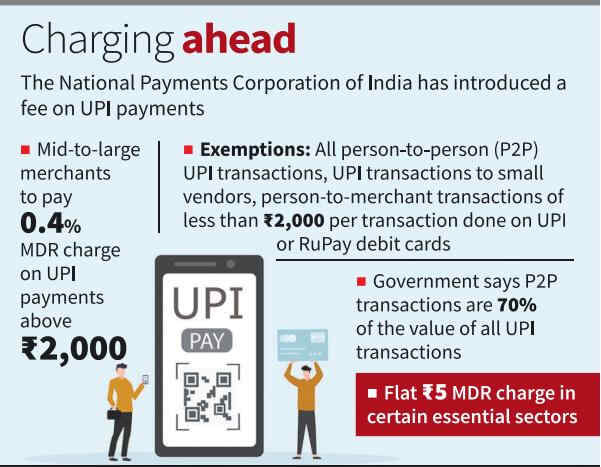
Historically, UPI transactions have largely operated under a zero-MDR framework, particularly for customers and most merchants.
While this helped accelerate digital payments, it also created concerns regarding the financial sustainability of the payment ecosystem, as banks and payment service providers incur costs for processing UPI transactions.
The new framework attempts to introduce a limited revenue mechanism while keeping a large proportion of everyday UPI transactions free.
According to the government, only around 4% of merchant transactions will be affected because most transactions are either below ₹2,000 or qualify for exemption.
Features
Category | MDR |
P2P transactions | Nil, irrespective of value |
P2M transactions up to ₹2,000 | Nil |
P2M above ₹2,000 | 0.4% |
P2PM small vendors receiving ≤ ₹1 lakh/month | Nil |
Railways, telecom, insurance, fuel & agricultural inputs above ₹2,000 | ₹5 flat MDR |
Mutual funds, securities, stock brokers & dealers | 0.02%, capped at ₹300 |
Transactions ≥ ₹75,000 | Overall MDR cap of ₹300 |
Important distinction
P2P ≠ P2M ≠ P2PM
P2P: Person → Person
P2M: Person → Merchant
P2PM: Person → Person Merchant, a classification for eligible small merchants.
Challenges
Impact on small merchants
Although small P2PM merchants are exempt, other merchants receiving larger-value payments could face additional transaction costs.
Possibility of cost pass-through
The government has advised banks to ensure that MDR is not passed on to customers, but monitoring compliance could be challenging.
Merchant acceptance
Additional charges may influence merchants' preference between UPI, cards, cash and other payment methods.
Digital-payment ecosystem sustainability
The zero-MDR model supported rapid UPI adoption, but generated questions about how banks, payment processors and apps could sustainably finance the infrastructure.
Rural and semi-urban penetration
If transaction costs discourage merchant participation, expansion of digital payments in low-volume areas could face difficulties.
Way Forward
Ensure transparent disclosure of MDR and prevent unauthorised customer charges.
Protect micro and small merchants through appropriate exemptions and targeted support.
Use a portion of MDR collections to strengthen rural and semi-urban digital-payment infrastructure.
Promote competition among banks, payment apps and processors to prevent high costs.
Periodically review the ₹2,000 threshold and sector-specific rates based on transaction patterns.
Strengthen consumer and merchant grievance-redress mechanisms.
Maintain interoperability and affordability, which have been central to UPI's expansion.
Conclusion
The proposed MDR framework is an effort to reconcile the affordability of UPI with its financial viability. By making P2P payments and select small merchant payments cost-free but charging fees for some high-value merchant transactions, it aims to generate a revenue stream that does not impose any fee on all UPI transactions. The success of this model will depend on its proper implementation, as well as on protecting small merchants from MDR being passed on to them.