Background
India is heavily dependent on imported crude oil and therefore seeks supplies from multiple countries.
Three cases illustrate the relationship between geopolitical restrictions and India's oil imports:
Venezuela
Venezuela accounted for 6.7% of India's oil imports in 2017–18.
After the U.S. expanded sanctions to Venezuela's oil sector in January 2019, its share declined.
It fell to 1.1% in 2020–21 and reached zero by 2021–22.
After restrictions were partially eased in 2026, Venezuela's share rose to 4.8% during April–July 2026.
Iran
Iran previously supplied around 10% of India's oil imports.
Following the reimposition of U.S. sanctions in 2018, its share declined to around 1% and subsequently to zero.
India reportedly imported no Iranian oil during 2020–26.
After limited sanctions relaxation in March 2026, Iran's share increased to 1.1% during April–July 2026.
Russia
After the Ukraine conflict began in 2022, India increased Russian crude purchases, partly because discounted Russian oil offered an attractive procurement opportunity.
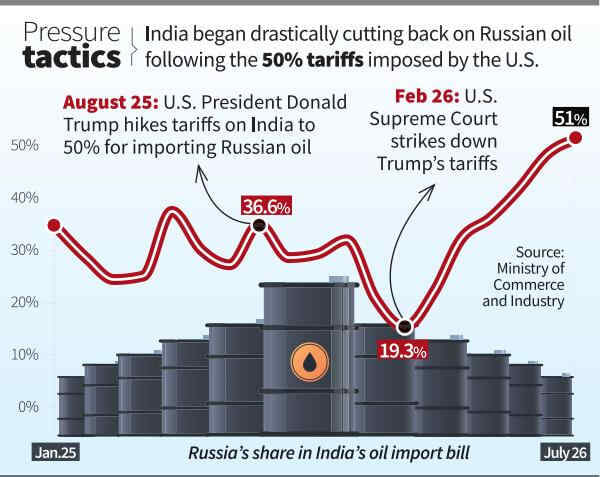
Russia's share remained around 30–40% during July 2024–July 2025.
Following the U.S. tariff increase on India in August 2025, Russia's share declined to 19.3% by February 2026.
After the U.S. tariff regime was struck down, Russian oil imports increased.
Russia's share reportedly exceeded 51% in July 2026.
Features
Impact of Secondary Sanctions
U.S. sanctions can affect countries that trade with sanctioned states even when those countries are not themselves the primary target.
Energy Diversification
India maintains that it purchases oil from diverse sources to protect energy security and reduce dependence on any single supplier.
Russia as a Major Supplier
Russia became a major source of Indian crude after 2022. The subsequent decline and recovery in Russia's share demonstrate how external economic restrictions can influence India's sourcing pattern.
Geopolitical Events Interact
The rise in Russian imports in 2026 also coincided with higher global oil prices and disruptions involving Iran and the Strait of Hormuz, making it difficult to attribute the entire increase solely to changes in U.S. tariff policy.
Challenges
Energy Security
Any sudden restriction on access to a major oil supplier could create supply-side pressures.
Higher Import Costs
Replacing discounted crude with alternative supplies may increase India's oil-import expenditure.
Strategic Autonomy
India seeks to maintain independent foreign-policy choices while simultaneously maintaining important relationships with the U.S., Russia, Iran and Gulf countries.
External Sanctions
Secondary sanctions can create uncertainty for Indian refiners, shipping companies, financial institutions and exporters.
Global Price Volatility
Disruptions in major producing regions or shipping routes can quickly increase international crude prices.
India–U.S. Relations
Differences over Russian oil purchases can create friction within the broader India–U.S. economic and strategic relationship.
Way Forward
Diversify crude-oil suppliers across Russia, the Middle East, the U.S., Africa and Latin America.
Strengthen Strategic Petroleum Reserves (SPR).
Increase flexibility of Indian refineries to process different grades of crude.
Expand renewable energy and energy-efficiency measures.
Promote electric mobility and alternative fuels to reduce petroleum dependence.
Maintain diplomatic engagement with major energy suppliers and trading partners.
Develop resilient shipping, insurance and financial mechanisms for legitimate energy trade.
Carefully assess the economic consequences of sanctions before altering long-term supply arrangements.
Preserve strategic autonomy while complying with applicable international and domestic legal obligations.
Conclusion
The analysis of Venezuela, Iran and Russia shows that the oil import behaviour of India has been dependent upon the sanction and tariff climate in the international community. Yet sanctions alone cannot explain the decisions behind oil imports because prices, discounts, availability and geopolitical problems also play a role in determining sourcing. For India, the way forward is to diversify sourcing, build strategic petroleum reserves and slowly shift to more sustainable energy resources. This will help India secure its energy security while preserving strategic autonomy.