Background
The nature of terrorism has changed significantly since 9/11. Earlier, major terrorist organisations operated through centralised command structures under leaders such as Osama bin Laden and Abu Bakr al-Baghdadi. Today, terrorism increasingly involves decentralised networks, lone actors and emerging technologies such as drones, cyber tools and AI. India has faced terrorism since the early 1990s, particularly Pakistan-sponsored cross-border terrorism in Kashmir.
Major incidents such as:
Rajiv Gandhi assassination (1991)
Mumbai serial blasts (1993)
IC-814 hijacking (1999)
Parliament attack (2001)
26/11 Mumbai attacks (2008)
Uri (2016)
Pulwama (2019)
Pahalgam (2025)
Nature of Global Terrorism
The rise of al-Qaeda and the Islamic State demonstrated the destructive potential of international terrorist organisations.
However, their decline as centralised structures has given rise to smaller, autonomous groups and individual attackers.
Modern terrorists exploit encrypted communications, digital propaganda, cyber operations, and emerging technologies.
These developments make it difficult to identify threats before attacks occur.
Counter-terrorism therefore requires not only military action but also intelligence-sharing, technological preparedness, and efforts to prevent radicalisation.
India’s Early Struggle with Cross-Border Terrorism
India’s experience with terrorism predates 9/11. The assassination of Rajiv Gandhi in 1991, the Mumbai serial blasts of 1993, and the Coimbatore blasts of 1998 exposed weaknesses in national security.
The IC-814 hijacking in 1999 forced India to release Pakistan-based terrorists, including Masood Azhar, demonstrating the limitations of its response mechanisms.
The Parliament attack in December 2001 led to Operation Parakram, but nuclear deterrence and international pressure prevented direct military action against Pakistan.
India’s Contemporary Counter-Terrorism Framework
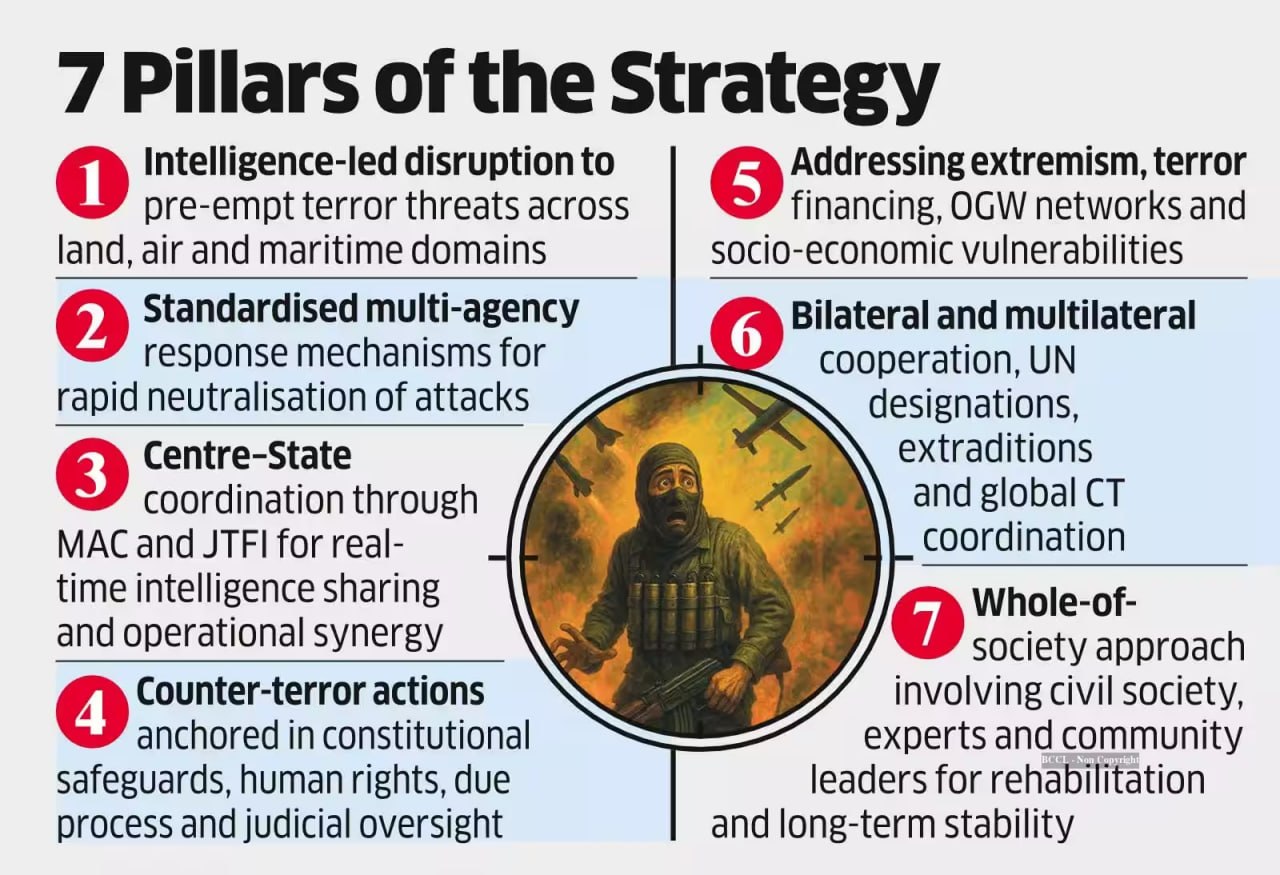
The launch of PRAHAAR, India’s National Counter-Terrorism Policy and Strategy, in February 2026 reflects the development of a comprehensive national framework.
Its emphasis on whole-of-government and whole-of-society approaches recognises that terrorism cannot be defeated through military force alone.
Four priorities are essential:
Eliminating Terrorist Networks: Security agencies must continue dismantling terrorist networks, particularly in Kashmir.
Preventive Military Action: India must maintain the capability to respond to emerging threats across the Line of Control.
De-radicalisation and Social Integration: Education, employment, community engagement, and rehabilitation can reduce the appeal of extremist ideologies.
Disrupting Terror Financing: International cooperation is necessary to trace and block financial networks supporting terrorist organisations.
Challenge
Changing nature of terrorism: Terrorism is becoming decentralised, making conventional intelligence and military responses more difficult.
Cross-border terrorism: Terrorist infrastructure can operate outside India's territory, particularly across the LoC, complicating attribution and response.
Technology-enabled terrorism: Drones, encrypted communication, cyber capabilities, social media and AI can facilitate recruitment, surveillance, financing and attacks.
Radicalisation: Online propaganda can radicalise vulnerable sections of society without requiring direct physical contact with terrorist organisations.
Terror financing: Terror networks require sustained financial channels, often operating through sophisticated and transnational mechanisms.
Nuclear dimension: India's response to Pakistan-sponsored terrorism is constrained by the possibility of escalation between two nuclear-armed states.
Intelligence and infiltration: Even when large networks are dismantled, small groups of infiltrators can evade security agencies and conduct attacks.
The Importance of International Cooperation
Terrorism is a transnational threat requiring coordinated international action.
India has used platforms such as the Shanghai Cooperation Organisation and BRICS to oppose countries that support or shelter terrorists.
The inclusion of a paragraph on the Pahalgam attack in the BRICS Delhi Declaration reflects growing international recognition of India’s security concerns.
India’s consistent opposition to double standards on terrorism is essential for building an effective global response.
Way Forward
Eliminate remaining networks. Continue intelligence-led operations against terrorist remnants, especially in Jammu & Kashmir.
Pre-emptive action: Take preventive action against emerging terrorist threats and launch pads across the LoC when necessary.
De-radicalisation: Develop comprehensive programmes to prevent radicalisation, bring vulnerable youth into the mainstream and reduce recruitment into extremist organisations.
Target terror financing: Strengthen international cooperation to identify and disrupt the financial networks sustaining terrorism.
In addition, India needs to:
Strengthen counter-drone and cyber capabilities.
Improve intelligence sharing and inter-agency coordination.
Build stronger international cooperation against terrorism.
Implement the PRAHAAR framework through a whole-of-government and whole-of-society approach.
Maintain a balance between national security and civil liberties/rule of law.
Conclusion
The main argument here is that terrorism does not exist anymore but rather has been transformed. It has shifted from terrorist organisations to decentralised networks of actors, lone wolves and technologically enabled attacks. As such, India’s anti-terrorist policy has transformed from passiveness and restraint to proactivity and deterrence through this change. From the Parliament attack, 26/11, to Uri, Balakot and Operation Sindoor, the transformation can be traced. Nevertheless, it should be noted that a mere military approach will not yield lasting results and thus requires a comprehensive approach.