Background
The programme is called ‘Aadi’, a farmer carbon programme launched by Grow Indigo in 2019, with technical guidance from ICAR.
Farmers adopted practices aimed at reducing emissions and improving soil health during 2019–2022.
Major practices included:
Direct Seeded Rice (DSR)
Reduced/minimum tillage
Crop-residue management
The programme seeks to connect sustainable agricultural practices with carbon markets.
It reportedly covers more than 2 million acres, over 1 lakh farmers and seven States.
Key Highlights
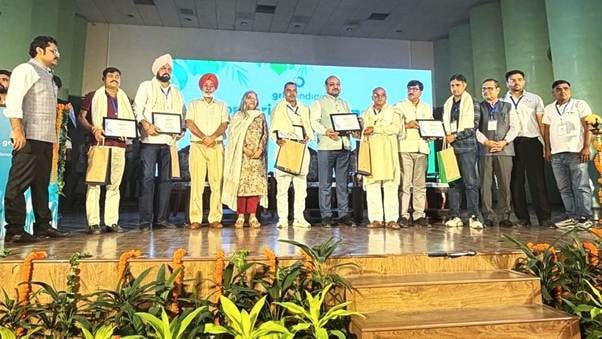
Direct Benefit Transfer
Around 2,550 farmers in Punjab and Haryana received payments through DBT.
The total payment is estimated at more than ₹2.9 crore.
Carbon Credits
The reduction in greenhouse gas emissions and increase in soil carbon were measured and independently verified.
Carbon credits were issued using the Verra VM0042 methodology.
Farmers receive payments corresponding to their contribution to the carbon credits generated from their agricultural land.
First Carbon-Credit Issuance
The first issuance covered approximately 30,000 acres.
More than 50,000 carbon credits were generated.
Participating farmers received approximately ₹3,000–₹15,000, depending on their contribution.
Revenue-Sharing Model
Farmers had the option of:
Receiving an assured upfront payment, or
Receiving 75% of net carbon revenue after the carbon credits were sold.
Pre-financing
Grow Indigo reportedly made payments from its own funds before the carbon credits were fully sold, helping farmers receive income without waiting for the entire carbon-market transaction to be completed.
Environmental Benefits
For enrolled fields during 2019–2022, the programme estimates:
Around 45 billion litres of water saved
More than 2 lakh tonnes of crop residue prevented from burning
Around 1,000 tonnes of PM2.5 emissions avoided
Improved soil-carbon levels through changes in cultivation practices
Significance
For Farmers
Provides an additional income opportunity beyond conventional agricultural output.
Creates a financial incentive for adopting sustainable farming practices.
May encourage improvements in soil health and resource efficiency.
For Environment
Reduced crop-residue burning can help address air pollution, particularly in northwestern India.
Reduced tillage and improved soil management can contribute to soil-carbon sequestration.
DSR can reduce water requirements compared with conventional transplanted rice under suitable conditions.
For Agriculture
Demonstrates how carbon markets can potentially be linked with agricultural policy and farmer livelihoods.
Encourages measurement-based approaches to climate-smart agriculture.
Challenges
Measurement and Verification
Accurately measuring additional soil-carbon sequestration and emission reductions across millions of acres is technically complex.
Permanence of Soil Carbon
Carbon stored in soil can potentially be released again if farming practices change.
Carbon-Market Price Volatility
Farmer income linked to carbon credits can vary according to credit prices and market demand.
Additionality
It must be established that the claimed emission reductions or carbon sequestration occurred because of the programme, rather than practices farmers would have adopted anyway.
Smallholder Participation
Carbon-credit programmes involve monitoring, verification and transaction costs, which can be difficult for small and marginal farmers.
Transparency
Farmers need clear information about:
How carbon credits are calculated
How much revenue is generated
Verification costs
The share received by farmers
Ownership and duration of carbon-related claims
Way Forward
Develop transparent and standardised methodologies for measuring soil carbon.
Reduce transaction and verification costs for small and marginal farmers.
Provide farmers with clear information about carbon-credit ownership and revenue sharing.
Strengthen independent monitoring and third-party verification.
Integrate carbon farming with existing programmes for soil health, water conservation and crop-residue management.
Promote region-specific practices rather than adopting a one-size-fits-all approach.
Improve farmers' access to reliable carbon markets and prevent excessive dependence on volatile carbon-credit prices.
Encourage greater participation of FPOs and cooperatives to aggregate small farms and reduce transaction costs.
Conclusion
The programme presents a new model whereby farmers can be paid according to their contributions to measurable environmental services. Through the integration of regenerative farming, soil carbon measurement, and carbon markets, such programmes may be able to tie the income of farmers with that of climate and resource conservation. The success of these programmes will, however, rely on accurate measurements and carbon market stability.