Background
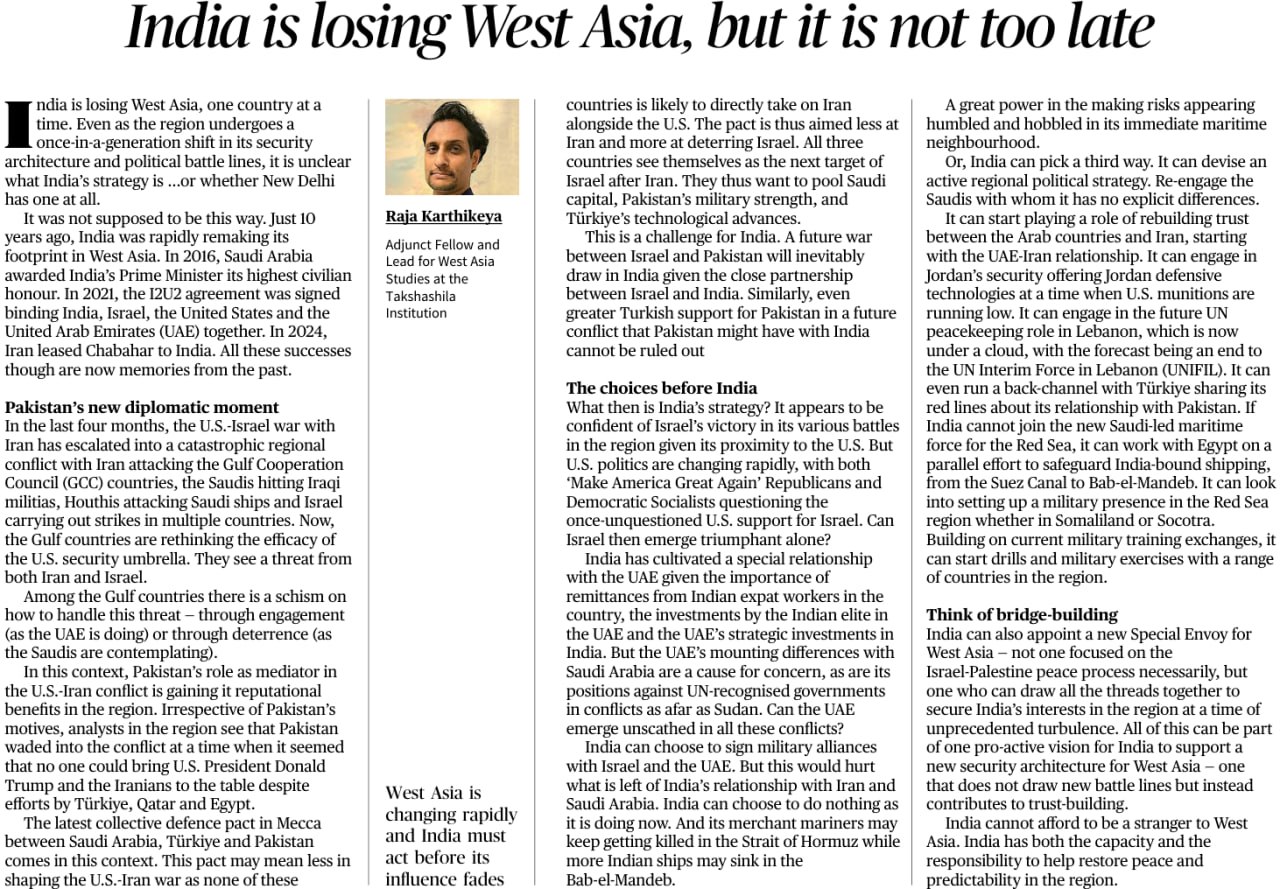
India has significantly expanded its engagement with West Asia over the past decade:
Saudi Arabia: India-Saudi relations have deepened through strategic, economic and defence cooperation.
I2U2: The grouping of India, Israel, UAE and the U.S. provides a framework for cooperation in food security, infrastructure, technology and investment.
Iran: India's engagement with Chabahar Port provides connectivity to Afghanistan and Central Asia while bypassing Pakistan.
UAE: The UAE has emerged as an important economic and strategic partner for India, including investment, trade and the large Indian diaspora.
Israel: Defence, technology, agriculture and security cooperation have become important pillars of bilateral relations.
However, the regional balance is changing rapidly, creating pressure on India's traditional policy of maintaining simultaneous relationships with competing regional powers.
Challenge
Changing Gulf security architecture
Gulf countries increasingly question the reliability of the traditional U.S. security umbrella amid regional conflicts.
They face threats from multiple directions, particularly Iran and Israel, and are considering different approaches ranging from engagement to deterrence.
Pakistan's growing diplomatic role
Pakistan's involvement as a mediator in regional conflicts has provided it with greater diplomatic visibility.
The emerging Saudi-Türkiye-Pakistan security cooperation is particularly significant for India because:
Saudi Arabia provides financial resources.
Pakistan contributes military capabilities.
Türkiye contributes technological and defence capabilities.
Greater strategic cooperation between Türkiye and Pakistan could also affect India's security calculations.
India-Israel relationship
India's strong strategic partnership with Israel creates a potential dilemma. Any future conflict involving Israel and Pakistan could indirectly affect India's strategic environment.
At the same time, India cannot afford to sacrifice its relationships with Iran, Saudi Arabia or the UAE merely to strengthen one regional partnership.
Why West Asia Matters to India
Energy security: West Asia remains critical to India's crude oil and gas supplies.
Indian diaspora: Millions of Indians live and work in Gulf countries and contribute substantially through remittances.
Trade: Gulf states are major trading partners and investors.
Maritime security: The Strait of Hormuz, Bab-el-Mandeb and Suez Canal are crucial for India's trade and energy flows.
Connectivity: Chabahar provides India with an alternative route towards Afghanistan and Central Asia.
Strategic influence: Stability in West Asia directly affects India's broader Indo-Pacific and Indian Ocean strategy.
Challenges for India
Balancing competing partnerships: Maintaining relations with Israel, Iran, Saudi Arabia, UAE and Türkiye simultaneously is increasingly difficult.
Maritime insecurity: Conflict around the Red Sea and Strait of Hormuz threatens Indian commercial shipping.
Energy-price volatility: Regional conflicts can disrupt oil supplies and increase India's import bill.
Pakistan-Türkiye cooperation: Greater defence cooperation could complicate India's security environment.
U.S. policy uncertainty: India's strategy cannot depend entirely on assumptions about continued U.S. support for particular regional actors.
Risk of strategic irrelevance: If India remains passive while regional powers construct new security arrangements, its influence could decline.
Way Forward
Adopt a proactive regional strategy.
India should move beyond a purely bilateral approach and develop a comprehensive West Asia strategy involving political, economic, diplomatic and security dimensions.
Balance rather than choose sides
India should avoid entering rigid military alliances that could damage relations with other important partners.
The preferred approach should be multi-alignment and strategic autonomy.
Re-engage Saudi Arabia
India should deepen political, economic, defence and technology cooperation with Saudi Arabia while encouraging greater Saudi-India coordination on regional stability.
Engage Iran
India should preserve its relationship with Iran, particularly through Chabahar Port, connectivity projects and regional diplomacy.
India could also encourage confidence-building between Iran and Gulf Arab states.
Strengthen maritime security
India should work with Egypt and other regional partners to protect shipping routes from the Suez Canal to the Bab-el-Mandeb and the Indian Ocean.
Conclusion
India's role in the West Asia region does not lie simply in choosing sides between Israel, Iran, or the Gulf States. Rather, its primary aim should be maintaining strategic space with all major players in the region while fostering regional stability. This could be achieved through an active policy of multi-alignment instead of merely being neutral. India can use its diplomatic, naval, economic, defence, and confidence-building capacities to act as a balancer and stabiliser in the region.