Background
Gross FDI refers to the total direct investment entering India, while net FDI considers inflows after accounting for investment flowing out through repatriation, disinvestment and outward investment.
India has remained an important destination for global investors because of its:
Large domestic market, relatively strong economic growth, expanding manufacturing base, digital and technological ecosystem, and government initiatives such as Make in India and production-linked incentives.
However, rising repatriation by foreign companies and increasing overseas investment by Indian firms have sometimes resulted in negative net FDI, even when gross inflows remained substantial.
Features
Record gross FDI
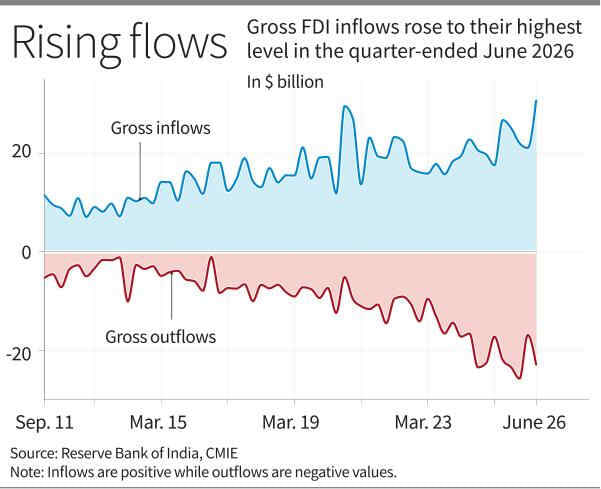
Gross FDI in Q1 FY2026-27: $30.7 billion.
It is the highest quarterly inflow in the available 15-year/60-quarter RBI dataset.
June witnessed strong inflows.
June 2026 inflows: $9.3 billion.
This was 53% higher than May 2026.
Singapore, the Netherlands, the US and Canada together contributed around 74% of June inflows.
Manufacturing leads
The major recipient sectors included: Manufacturing, Electricity generation, Computer services and Communication services.
The strong manufacturing share is particularly important for India's objective of developing domestic production and integrating into global value chains.
Net FDI became positiv.e
June 2026: +$1.3 billion
April–June 2026: +$7.8 billion
Moreover, net FDI was negative in only one of the last six months, compared with six of the previous 12 months.
Outflows remain significant
Total direct investment outflows in June: $7.9 billion.
Repatriation and disinvestment by foreign companies: $5.8 billion.
Outward FDI by Indian companies: $2.1 billion, down 13% from May and 30% year-on-year.
Challenge
The headline figure should not be interpreted as meaning that all concerns regarding FDI have disappeared.
First, gross FDI and net FDI tell different stories. High gross inflows can coexist with substantial repatriation and disinvestment.
Second, India needs more stable and long-term FDI. Portfolio-type or short-duration investment is less useful for building productive capacity than investment in manufacturing, infrastructure, technology and R&D.
Third, concentration remains a concern. A large share of inflows coming from a handful of countries means India should continue broadening its investor base.
Fourth, the investment environment needs continuous improvement. Regulatory predictability, ease of doing business, contract enforcement, logistics, land availability and skilled labour remain important determinants of FDI.
Way Forward
Deepen ease-of-doing-business reforms by simplifying regulations and reducing compliance costs.
Strengthen manufacturing ecosystems so that FDI creates domestic supply chains rather than merely assembling imported components.
Improve infrastructure and logistics to reduce the cost of doing business.
Promote technology-intensive FDI in areas such as semiconductors, electronics, renewable energy, advanced manufacturing and digital infrastructure.
Diversify the source countries for FDI to reduce dependence on a small group of investors.
Encourage reinvestment of profits by existing foreign companies in India.
Maintain policy stability and transparency, which are crucial for long-term investment decisions.
Conclusion
Gross FDI inflow of $30.7 billion per quarter is definitely a very positive development for the Indian economy and also reflects a growing level of investor confidence across the globe. But more importantly, the net positive FDI figure during the month of June 2026 shows that investments are beginning to surpass investment outflows. However, apart from the quantity of FDI, India needs to give importance to the quality of FDI. The ultimate aim of the country should be to translate FDI into employment, technology, exports, and production.


