Background
What was the BWSSB judgment?
The 1978 BWSSB judgment gave a broad interpretation of “industry” under Section 2(j) of the ID Act.
The famous Triple Test essentially examined whether:
There is a systematic activity;
It is organised through cooperation between employer and employee; and
It is carried out for the production/distribution of goods or services to satisfy human wants or wishes.
In BWSSB, the Supreme Court adopted a broad interpretation of industry based on a Triple Test involving systematic activity, employer-employee cooperation and production or distribution of goods or services.
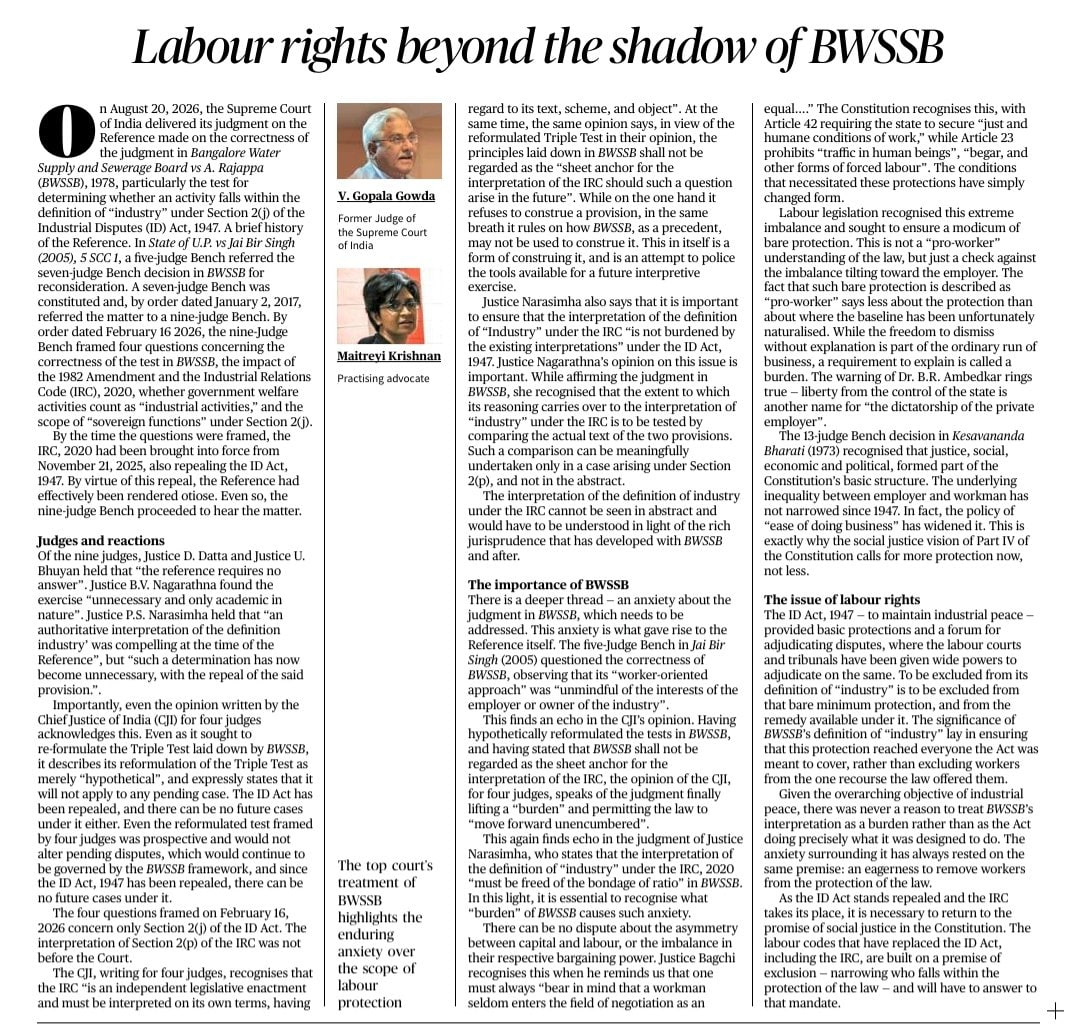
In State of U.P. v. Jai Bir Singh (2005), a five-judge Bench questioned BWSSB and referred it for reconsideration. A seven-judge Bench subsequently referred the matter to a nine-judge Bench in 2017.
The nine-judge Bench framed questions concerning the correctness of BWSSB, the 1982 amendment, the IRC, government welfare activities and sovereign functions.
Yet, with the repeal of the ID Act, the Reference had arguably become academic and otiose.
A Judgment on a Repealed Law
Several judges recognised the difficulty of deciding an issue concerning a repealed statute.
Justice D. Datta and Justice U. Bhuyan held that the Reference required no answer.
Justice B.V. Nagarathna described the exercise as unnecessary and academic, while Justice P.S. Narasimha noted that repeal had made the determination unnecessary.
This raises an important principle of judicial restraint. Courts generally decide live controversies rather than provide abstract interpretations of laws that no longer operate.
The IRC is an independent legislative enactment and must be interpreted according to its own language, structure and purpose.
Since Section 2(p) of the IRC was not directly before the Court, its interpretation should be left to an appropriate future case.
How did the Reference arise?
The BWSSB interpretation subsequently faced criticism.
In State of U.P. v. Jai Bir Singh (2005), a five-judge Bench questioned the correctness of the BWSSB and referred it for reconsideration by a larger Bench.
A seven-judge Bench was constituted, which ultimately referred the matter to a nine-judge Bench in 2017.
On February 16, 2026, the nine-judge Bench framed four broad questions concerning:
correctness of the BWSSB Triple Test;
effect of the 1982 amendment to the ID Act;
impact of the Industrial Relations Code, 2020;
whether government welfare activities constitute “industrial activities”; and
the scope of “sovereign functions.”
But there was a fundamental problem: the ID Act had already been repealed.
Why BWSSB Became Controversial
The deeper controversy concerns the perceived pro-worker character of BWSSB.
Jai Bir Singh criticised its worker-oriented approach for allegedly overlooking employers’ interests. Similar concerns appear in the present judgment through references to freeing labour law from the perceived burden of BWSSB.
However, employer and worker do not generally possess equal bargaining power. Labour law exists precisely because contractual freedom cannot eliminate structural inequality.
Feature: Why BWSSB Matters Beyond the Judgment
The deeper significance of the controversy lies not merely in statutory interpretation but in the philosophy of labour rights.
Employer–worker bargaining is unequal.
There is an inherent asymmetry between capital and labour.
A worker generally does not negotiate with an employer from an equal bargaining position.
Therefore, labour legislation historically attempted to provide workers with a minimum protective framework.
Calling such an approach “pro-worker” can obscure the underlying reality:
Labour protection is often an attempt to correct an existing structural imbalance rather than to create an artificial advantage for workers.
Constitutional foundation
The issue connects directly with the constitutional vision of social justice.
Article 42 directs the State to secure:
Just conditions of work; and
Humane conditions of work.
Article 23 prohibits:
Trafficking in human beings;
Begar; and
Other forms of forced labour.
Further, the Supreme Court in Kesavananda Bharati (1973) recognised social, economic and political justice as part of the Constitution's basic structure.
Therefore, labour law cannot be viewed merely as an instrument for regulating employers and employees. It is also connected with the constitutional commitment to social justice.
Constitutional Social Justice and Labour Reform
The Constitution places social and economic justice at the heart of governance.
Article 42 requires the State to secure just and humane working conditions, while Article 23 protects against forced labour and exploitation.
The unequal relationship between capital and labour remains relevant amid privatisation, contractualisation, informal employment and ease-of-doing-business reforms.
Labour reform must therefore balance economic flexibility with worker dignity and fair working conditions.
Economic liberty without bargaining equality can enable private domination. Labour protections are consequently not merely pro-worker; they are safeguards against structural inequality.
Way Forward
First - Interpret the IRC independently
Courts should interpret the Industrial Relations Code according to its language, legislative scheme and objectives.
Second - Preserve valuable labour jurisprudence
Repeal of the ID Act should not automatically erase the underlying principles of fairness, natural justice and social justice developed through decades of judicial decisions.
Earlier precedents should be used where their reasoning is compatible with the new statute.
Third - Maintain minimum labour protection
Economic reforms should not reduce workers to a position where they have little practical remedy against arbitrary or exploitative employment practices.
Fourth - Balance ease of doing business with dignity of labour
A competitive economy requires businesses to remain viable, but economic efficiency cannot become a justification for dismantling the constitutional commitment to just and humane conditions of work.
Fifth - Legislative clarity
Parliament should provide clearer statutory definitions and exclusions so that fundamental questions concerning who receives labour-law protection are not left entirely to judicial interpretation.
Conclusion
The BWSSB case is, in fact, more important than simply the reading of Section 2(j) of an expired law. What is important in the end is the way in which India will try to reconcile economic liberty, employers’ rights, and workers’ protections in the new labour-code era. As the Supreme Court Reference of 2026 shows, the context has certainly changed, because the ID Act has ceased to exist and IRC has taken its place. Therefore, the future reading of the word “industry” should emanate from the new Code.