Quick answer: what is the APAAR ID and why is it in the news?
APAAR is the Automated Permanent Academic Account Registry, a 12-digit lifelong student identification number issued under the One Nation, One Student ID initiative flowing from the National Education Policy 2020. In July 2026 the Supreme Court directed the Centre and the CBSE to give parents an express opt-out option in the consent form and held the entire scheme subject to the Digital Personal Data Protection Act, 2023.
Syllabus mapping
- Prelims: APAAR, Academic Bank of Credits, National Academic Depository, DigiLocker, UDISE+ and the Permanent Education Number, NEP 2020, DPDP Act 2023, Article 21A, Concurrent List Entry 25.
- Mains GS-2 (Governance): Government policies and interventions — issues in design and implementation; e-governance; transparency and accountability.
- Mains GS-2 (Polity): Fundamental Rights — right to privacy, proportionality, judicial review of executive action.
- Mains GS-2 (Social Justice): Development and management of social services relating to education; exclusion of vulnerable groups.
Why in news
On 20 July 2026, a three-judge Bench of the Supreme Court comprising Chief Justice of India Surya Kant, Justice Joymalya Bagchi and Justice V. Mohana heard a writ petition under Article 32 challenging the constitutional validity of the APAAR Scheme. The petitioners were parents of students in CBSE-affiliated schools, represented by senior advocate Indira Jaising.
The Court declined to strike the scheme down, but issued directions that materially change how APAAR must be implemented. It ordered the model consent form amended to expressly allow parents or guardians to withhold or refuse consent, extending pan-India a direction first issued by the Orissa High Court. It recorded that all processing of student data under APAAR is governed by the Digital Personal Data Protection Act, 2023, irrespective of the scheme being administrative rather than statutory. And it held that such data cannot be disclosed to any private entity or third party except in accordance with law.
The order was carried in the Indian Express UPSC Key of 26 July 2026, alongside the Sarnath UNESCO inscription and the notification of Vizhinjam as a customs port — a fair signal of its exam relevance.
Background and core concept: what APAAR actually is
Start with the problem APAAR was built to solve. An Indian student's academic record is scattered: a school-leaving certificate with one board, a degree with a university, a skill certificate with a sector skill council, a scholarship record with a state department. Every transition requires re-verification of paper documents, and fake certificates thrive in that fragmentation.
APAAR is the identifier layer designed to fix that — a unique 12-digit number attaching to a learner from pre-primary onwards that does not change with institution, board or state. It is not a database of marks; it is the key that lets verified records be pulled together and authenticated.
The three systems APAAR sits on top of
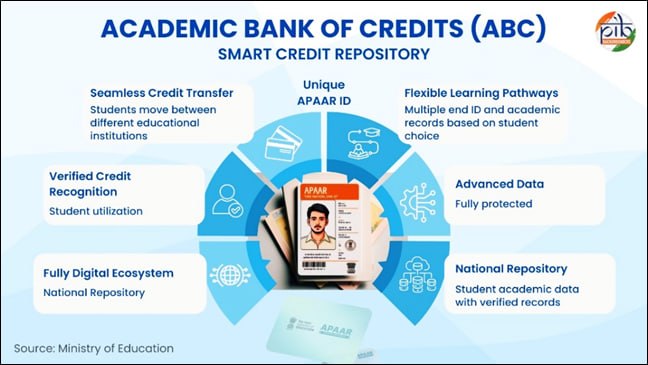
- Academic Bank of Credits (ABC): a digital credit repository regulated by the University Grants Commission, into which recognised award-granting institutions deposit the credits a learner earns. The APAAR ID functions as the account number for this credit account. Higher-education learners registering on the ABC portal receive an ABC ID, which has been renamed the APAAR ID.
- DigiLocker: the government document wallet under the Digital India programme, through which a student accesses issued certificates and through which Aadhaar-based verification is performed.
- National Academic Depository (NAD): the channel through which institutions and awarding bodies push verified academic records into the system. According to the Ministry of Education, school education records will also be creditised and mapped to the APAAR ID under NAD-ABC.
For school students, data is seeded from UDISE+ — the Unified District Information System for Education Plus — which already assigns each enrolled child a Permanent Education Number (PEN). UDISE+ is the Ministry of Education's school-level administrative data system covering enrolment, teachers, infrastructure and facilities. In remote and underserved areas, APAAR IDs can also be generated at the nearest Common Service Centre.
Where NEP 2020 fits
This is the linkage examiners look for. NEP 2020 promised multiple entry and multiple exit: leave after one year with a certificate, after two with a diploma, after three with a degree, and return later to complete. That is unworkable without a credit ledger following the person rather than the institution. NEP 2020 therefore proposed the Academic Bank of Credits, operationalised by the UGC (Establishment and Operation of Academic Bank of Credits in Higher Education) Regulations, 2021. APAAR is the identity spine that makes the ledger addressable. Policy promise, credit bank, unique ID — read in that sequence, the logic is coherent.
Key facts and figures
| Particular | Detail |
|---|---|
| Full form | Automated Permanent Academic Account Registry |
| Popular branding | One Nation, One Student ID |
| Format | Unique 12-digit number |
| Nodal ministry | Ministry of Education |
| Legal status | Administrative scheme; no parent statute |
| Policy origin | National Education Policy 2020 |
| Linked platforms | Academic Bank of Credits, DigiLocker, National Academic Depository |
| School data source | UDISE+ (Permanent Education Number) |
| ABC regulator | University Grants Commission |
| IDs generated | 26.35 crore verified APAAR IDs as of 2 July 2026 (PIB factsheet) |
| Consent circular | Ministry of Education, 11 October 2023 — parental consent a prerequisite for minors |
| CBSE circulars | 5 August 2025 and 27 August 2025 — APAAR ID made a precondition for Class IX-XII board registration from session 2026 |
| High Court ruling | Rohit Anand Das v. State of Odisha, Orissa High Court, 12 December 2025 |
| Supreme Court order | 20 July 2026; Bench of CJI Surya Kant, Justices Joymalya Bagchi and V. Mohana |
| Governing data law | Digital Personal Data Protection Act, 2023 |
Detailed explainer: how the scheme reached the Supreme Court
The litigation history matters more than the scheme description, because it is where the analysis lives.
Step one: the consent circular of 2023
The Ministry of Education, by circular of 11 October 2023, made parental consent a prerequisite for generating a student's APAAR ID. On its face a safeguard. The petitioners' complaint was about the form it took: the prescribed form neither offered an option to decline nor disclosed the purpose, scope, retention period or data-sharing practices. Consent that can only be withdrawn after enrolment is weaker than consent that can be refused at the outset.
Step two: the CBSE circulars of August 2025
The Central Board of Secondary Education then issued circulars dated 5 August 2025 and 27 August 2025 making the generation of an APAAR ID a mandatory precondition for registering students of Classes IX to XII for board examinations from the academic session 2026. This is the pivot point. A voluntary scheme became, for a large cohort of students, a gateway condition for taking the single examination that determines their next step in life.
The petition put it plainly: although formally announced as voluntary, the scheme was being enforced in a de facto mandatory manner, with students compelled by institutions acting under state directives to furnish Aadhaar details under threat of denial of admission or access to services.
Step three: the Orissa High Court
In Rohit Anand Das v. State of Odisha (W.P.(C) No. 8285 of 2025), decided 12 December 2025 by Justice Sashikanta Mishra, the Orissa High Court heard the father of a kindergarten student whose school had sought Aadhaar details for an APAAR ID. The Court held that the model consent form did not reflect the government's own position that APAAR is voluntary, because it permitted only withdrawal after enrolment rather than an upfront refusal. Relying on Puttaswamy, it held that children enjoy heightened privacy protection and that education cannot be conditioned on Aadhaar. Paragraph 19 directed authorities to amend the form to include an opt-out, within two months.
Crucially, the Centre did not appeal that judgment. That fact did a great deal of work in the Supreme Court.
Step four: the Supreme Court order of 20 July 2026
Because the High Court's ruling stood unchallenged, the Supreme Court adopted its approach rather than re-examining the question afresh. The operative directions were:
- The directions in paragraph 19 of the Orissa High Court judgment shall be given effect on a pan-India basis by the authorities implementing the APAAR Scheme. The Court observed that such a safeguard is essential to ensure that the requirement of consent is "meaningful and informed".
- Any collection, processing, storage, retention, sharing or use of personal information under the APAAR Scheme is strictly governed by the DPDP Act, 2023, and the obligations cast thereunder upon Data Fiduciaries — and the fact that the scheme is administrative rather than statutory does not dilute this.
- Personal information collected under APAAR cannot be disclosed, shared or made available to any private entity or third party except in accordance with law and strictly for authorised purposes.
"Any collection, processing, storage, retention, sharing, or use of personal information under the APAAR Scheme shall, therefore, be strictly governed by the provisions of the Digital Personal Data Protection Act, 2023, and the obligations cast thereunder upon data fiduciaries to ensure the lawful, secure, and purpose-limited processing of personal data." — Supreme Court order, July 2026
Note what the Court did not do. It did not declare APAAR unconstitutional, require a statute, or strike down the CBSE circulars. It treated concerns about misuse of voluntarily enrolled students' data as misconceived, since the DPDP Act already governs that processing. This is judicial regulation of implementation, not of policy — a distinction worth making explicitly in a Mains answer.
Multi-dimensional analysis
The efficiency case, taken seriously
Treating APAAR as merely a surveillance instrument is lazy. The administrative gains from a persistent learner identifier are real. Migrant children who change schools mid-session currently vanish from one register and reappear in another as fresh enrolments, corrupting dropout statistics and entitlement delivery. Credit transfer under multiple entry-exit is impossible without portable identity. Certificate fraud becomes far harder when a verified record can be pulled in seconds.
The 26.35 crore verified IDs reported by PIB as of 2 July 2026 indicate something close to universal coverage in enrolled cohorts. Whatever one thinks of the design, this is not a pilot.
The consent problem
The sharpest analytical point is not really about APAAR. Consent means nothing when the alternative to giving it is exclusion from a public entitlement. A parent asked to consent when refusal means their child cannot register for the Class X board examination is not exercising choice. That is the classic critique of consent-based data governance under unequal power, met before in the Aadhaar litigation.
The Court's remedy targets precisely this. An express refusal option converts a formality into a decision. Whether it works depends on whether refusing carries consequences — an implementation question the order left open.
The legality dimension: a scheme without a statute
APAAR rests on ministry circulars and board directions, not an Act of Parliament. Under the Puttaswamy framework, the first requirement for a privacy-restricting measure is legality — the existence of a law. The Court sidestepped this by locating legal discipline in the DPDP Act rather than a dedicated APAAR statute. Workable, but a structural gap remains: the DPDP Act regulates how data is processed; it does not authorise collection of a dataset for a purpose, nor specify retention periods or the boundaries of future use.
Compare Aadhaar, which began as an executive scheme in 2009 and acquired statutory footing only through the Aadhaar Act, 2016. The APAAR question is whether that sequence is being repeated.
Function creep and the lifetime record of a minor
A record created for a four-year-old and maintained for life is qualitatively different from an adult opening a bank account. The child cannot consent, cannot assess risk, and cannot anticipate what the data will be used for in 2050. Independent researcher Srinivas Kodali has flagged over-profiling and exclusion risks, citing earlier data exposure at the Ministry of Education's Diksha portal. Mishi Choudhary of the Software Freedom Law Centre argues that mass enrolment directed at schools without legal sanction amounts to forcing parental consent.
The counter deserves airing: most of these risks attach to UDISE+ and the PEN too, which have existed for years without comparable controversy. What changed is the Aadhaar linkage and lifelong persistence.
The exclusion dimension
Digital identity systems in India have a consistent failure mode: marginal cases fail first. A child of migrant parents without Aadhaar, a child in a shelter home, a child whose parents' names are spelt differently across documents — for these students ID generation stalls. Tie the ID to examination registration and an administrative failure becomes denial of educational opportunity. Article 21A does not tolerate that easily.
The federal dimension
Education sits in Entry 25 of the Concurrent List, moved from the State List by the Forty-second Amendment in 1976. APAAR is not legislation, so the question is administrative coordination rather than legislative competence. But the friction is visible: The Hindu reported that Uttar Pradesh warned of mismatches between APAAR generation and enrolment data and threatened to de-recognise madarsas that had not begun the process — an illustration of how a "voluntary" central scheme hardens as it travels down the administrative chain.
Comparative and global perspective
| Jurisdiction | Approach to student identifiers and data |
|---|---|
| India (APAAR) | Nationwide 12-digit lifelong ID, Aadhaar-linked, administrative basis; governed by the DPDP Act, 2023; opt-out mandated by the Supreme Court in 2026 |
| United States (FERPA) | The Family Educational Rights and Privacy Act, 1974 gives parents rights over education records and restricts disclosure; identifiers are largely state-level rather than federal |
| European Union (GDPR) | Data minimisation and purpose limitation are binding; the default age of digital consent is 16, which member states may lower to 13; a supervisory authority enforces with fines |
| Estonia | A single national digital identity underpins education records, but with a legally enforceable data-tracker letting citizens see every official access to their data |
Two features are worth borrowing in an answer. Most mature systems separate the identifier from the record store and log every access, making misuse detectable rather than merely prohibited. And they attach the strongest protections to the youngest data subjects — India's DPDP Act does this on paper by setting childhood at 18, above the GDPR default, but the enforcement machinery is still being built.
Committee, court and expert views
Justice K.S. Puttaswamy (Retd.) v. Union of India (2017): a nine-judge Bench held unanimously that privacy is a fundamental right intrinsic to Article 21. Restrictions must satisfy the proportionality test — a law, a legitimate State aim, rational nexus and necessity, and procedural safeguards. Every serious APAAR critique applies this test.
The Aadhaar judgment (2018): the Court upheld Section 7, permitting Aadhaar for subsidies and benefits drawn from the Consolidated Fund, while striking down Section 57, which had allowed private entities to demand Aadhaar. It also held that children cannot be denied benefits for want of Aadhaar — the direct ancestor of the Orissa High Court's reasoning.
Justice B.N. Srikrishna Committee (2018): its report A Free and Fair Digital Economy built Indian data protection doctrine around purpose limitation, data minimisation and a strong regulator. The DPDP Act, 2023 is leaner, which is why critics argue the statutory backstop the Court relies on is thinner than envisaged.
The Orissa High Court (December 2025): its finding that a consent form allowing only post-enrolment withdrawal does not reflect a genuinely voluntary scheme is the most quotable line of doctrine in the episode.
The Supreme Court (July 2026): declined to strike the scheme down, mandated the opt-out, anchored the scheme in the DPDP Act and barred third-party sharing. Calibrated intervention rather than constitutional confrontation.
Way forward
- Redesign the consent form as a specified template, not a general instruction. A single national form in the regional language stating the exact fields collected, purposes, retention period, entities with access, and a tick-box for refusal — with signed forms uploaded to UDISE+ so refusal rates are auditable.
- Decouple APAAR from board examination registration. The CBSE circulars of August 2025 are the source of the compulsion problem. An alternative registration route using the existing UDISE+ PEN preserves the administrative benefit, removes the coercive edge and pre-empts the next round of litigation.
- Legislate a narrow enabling statute. A short Act specifying permitted uses of an academic identifier, capping retention after the last academic transaction and creating an offence for use outside those purposes would satisfy the legality limb of Puttaswamy.
- Build an access log visible to the student. Estonia's model transplants directly. Every institutional query against an APAAR record should be logged and visible on DigiLocker. Detectability deters misuse far better than a prohibition nobody can verify.
- Notify the Data Protection Board and publish a sectoral code for education covering breach notification timelines, encryption standards and legacy children's data collected before 2023. The DPDP Act is the Court's chosen instrument of discipline; it needs an operational regulator.
- Create an exception pathway for undocumented children. District education officers should be empowered to enrol and examine a child without an APAAR ID on recorded reasons, with the ID generated later. Without that valve, the exclusion risk is not theoretical.
Static and current linkage
- Laxmikanth, Indian Polity: Fundamental Rights — Article 21 and the right to privacy; Article 21A and the Right to Education; judicial review; the Seventh Schedule and the Concurrent List.
- NEP 2020: Academic Bank of Credits, multiple entry and exit, credit transfer, National Educational Technology Forum. The policy was drafted by a committee chaired by K. Kasturirangan.
- Right of Children to Free and Compulsory Education Act, 2009: free and compulsory education for children aged 6 to 14; bar on denial of admission for want of documents — read this alongside the exclusion critique.
- Digital Personal Data Protection Act, 2023: Data Principal, Data Fiduciary, Consent Manager, Significant Data Fiduciary, Data Protection Board of India; Section 9 on children's data.
- India Stack: Aadhaar, UPI, DigiLocker, e-Sign, Account Aggregator — APAAR is the education-sector extension of the same architectural idea.
- Economic Survey and Ministry of Education annual reports: UDISE+ enrolment, Gross Enrolment Ratio and dropout data — useful for substantiating the migrant-child argument.
Prelims pointers
- APAAR stands for Automated Permanent Academic Account Registry — a 12-digit unique student ID.
- Branding: One Nation, One Student ID; nodal ministry: Ministry of Education.
- It has no statutory basis; its policy origin is the National Education Policy 2020.
- The Academic Bank of Credits is regulated by the UGC; the ABC ID was renamed the APAAR ID.
- Credits reach the ABC through the National Academic Depository; DigiLocker is the access and verification layer.
- School data comes from UDISE+, which assigns a Permanent Education Number (PEN).
- APAAR IDs can be generated at Common Service Centres in remote areas.
- PIB factsheet: 26.35 crore verified APAAR IDs as of 2 July 2026.
- Parental consent circular of the Ministry of Education: 11 October 2023.
- CBSE circulars making APAAR a board-registration precondition: 5 and 27 August 2025.
- Orissa High Court case: Rohit Anand Das v. State of Odisha, decided 12 December 2025.
- Supreme Court Bench of July 2026: CJI Surya Kant, Justice Joymalya Bagchi, Justice V. Mohana.
- The petition was filed under Article 32.
- Under the DPDP Act, 2023, a "child" is a person below 18 years; Section 9 requires verifiable parental consent.
- The DPDP Act creates the Data Protection Board of India.
- Justice K.S. Puttaswamy v. Union of India (2017) was decided by a nine-judge Bench.
- The Aadhaar judgment (2018) upheld Section 7 and struck down Section 57 of the Aadhaar Act, 2016.
- Article 21A makes education a fundamental right for children aged 6 to 14; inserted by the 86th Constitutional Amendment, 2002.
- Education is Entry 25 of the Concurrent List, Seventh Schedule.
Mains linkage
Probable question 1 (GS-2, 15 marks): "Digital identity systems promise efficiency but risk exclusion. Critically examine with reference to the Automated Permanent Academic Account Registry."
Skeleton: What APAAR is and the problem it solves → the efficiency case (migrant tracking, credit portability, certificate fraud) → the exclusion failure mode and why marginal cases fail first → the consent problem created by the CBSE circulars → the Court's calibrated remedy → recommendations preserving benefit while removing coercion. Keywords: purpose limitation, function creep, de facto compulsion, Article 21A, proportionality, exclusion error.
Probable question 2 (GS-2, 15 marks): "The Supreme Court's July 2026 order on the APAAR Scheme illustrates judicial regulation of implementation rather than of policy. Discuss."
Skeleton: The three directions → what the Court declined to do (no striking down, no statutory requirement, no interference with CBSE circulars) → doctrinal basis in Puttaswamy and the Aadhaar judgment → significance of the Centre not appealing Orissa → assessment: adequate on consent, silent on legality. Keywords: judicial review, legality limb, Data Fiduciary, meaningful and informed consent.
Probable question 3 (GS-2, 10 marks): "Is the Digital Personal Data Protection Act, 2023 an adequate safeguard for children's data in government schemes? Examine."
Skeleton: Section 9 and the verifiable-consent requirement → the age threshold of 18, higher than the GDPR default → the bar on tracking and targeted advertising → gaps: no dedicated regulator functioning at scale, wide exemptions for the State, no specified retention limits for scheme data → the APAAR illustration → what an education-sector code should contain.
Mains practice question with model answer structure
Q. "A voluntary scheme enforced through the gateway of a public examination ceases to be voluntary." Examine this proposition with reference to the APAAR Scheme and the Supreme Court's directions of July 2026. (250 words, 15 marks)
Introduction (about 30 words): Define APAAR as a 12-digit lifelong academic identifier under NEP 2020, note the government's stated position that it is voluntary, and flag the CBSE circulars of August 2025 as the point where that claim came under strain.
Body — how voluntariness collapsed (about 70 words): The 11 October 2023 circular requiring parental consent but offering no refusal option; CBSE circulars making the ID a precondition for Class IX-XII board registration from session 2026; state-level pressure such as the Uttar Pradesh warning on enrolment mismatches; consent under threat of exclusion is not free consent.
Body — the constitutional test (about 70 words): Puttaswamy proportionality — legality, legitimate aim, necessity, safeguards; APAAR's legitimate aim is unquestionable but its legality limb is weak absent a statute; the Aadhaar judgment's holding that children cannot be denied benefits for want of Aadhaar; Article 21A read with the RTE Act, 2009 bars conditioning education on documentation.
Body — the judicial response and its limits (about 50 words): The pan-India opt-out direction; anchoring the scheme in the DPDP Act, 2023; the bar on third-party sharing; but the Court declined to require a statute or disturb the CBSE circulars, so the underlying compulsion persists unless the executive acts.
Conclusion (about 30 words): Voluntariness must be structural, not declaratory. Decoupling the ID from examination registration and enacting a narrow enabling statute would deliver the scheme's genuine benefits without the constitutional cost.
Key terms glossary
- APAAR: Automated Permanent Academic Account Registry — a 12-digit lifelong unique academic identifier for Indian students.
- Academic Bank of Credits (ABC): a UGC-regulated repository that stores, transfers and redeems credits earned across recognised institutions.
- National Academic Depository (NAD): the system through which institutions deposit verified academic awards and credits.
- UDISE+: the Ministry of Education's school-level administrative database.
- Permanent Education Number (PEN): the identifier already assigned to enrolled school students within UDISE+.
- Data Fiduciary: under the DPDP Act, 2023, the entity that determines the purpose and means of processing personal data.
- Data Principal: the individual to whom the data relates; for a child, it includes the parent or lawful guardian.
- Verifiable consent: under Section 9, parental consent confirmed by due diligence to come from an identifiable adult.
- Function creep: gradual widening of a dataset's use beyond its original purpose.
- Proportionality test: the four-part standard from Puttaswamy — legality, legitimate aim, rational nexus and necessity, procedural safeguards.
- Multiple entry and exit: the NEP 2020 provision allowing learners to leave with a certificate, diploma or degree and re-enter later on banked credits.
Quick revision summary
- APAAR = Automated Permanent Academic Account Registry; a 12-digit lifelong student ID.
- Branded as 'One Nation, One Student ID'; flows from the National Education Policy 2020.
- Nodal ministry: Ministry of Education. Not backed by any statute — it is an administrative scheme.
- Linked to the Academic Bank of Credits (ABC), DigiLocker and the National Academic Depository (NAD).
- School data is seeded from UDISE+, which already assigns a Permanent Education Number (PEN).
- PIB factsheet: 26.35 crore verified APAAR IDs generated as of 2 July 2026.
- The ABC is regulated by the University Grants Commission.
- Ministry of Education circular of 11 October 2023 made parental consent a prerequisite for minors.
- CBSE circulars of 5 August 2025 and 27 August 2025 made an APAAR ID mandatory for Class IX-XII board registration from session 2026.
- Orissa High Court, Rohit Anand Das v. State of Odisha (12 December 2025): consent form must carry an opt-out/refusal option.
- Supreme Court, 20 July 2026: Bench of CJI Surya Kant, Justices Joymalya Bagchi and V. Mohana; extended that direction pan-India.
- The Court refused to interfere with the scheme itself but held it fully governed by the DPDP Act, 2023.
- Student data cannot be shared with private entities or third parties except in accordance with law.
- Section 9, DPDP Act, 2023 requires verifiable parental consent before processing a child's personal data (child = below 18).
- Key precedents: Justice K.S. Puttaswamy (2017) on privacy and proportionality; the Aadhaar judgment (2018) on Section 7 and children.
Frequently asked questions
What is the full form of APAAR and what does it do?
APAAR stands for Automated Permanent Academic Account Registry. It is a unique 12-digit identification number assigned to a student that stays with them from pre-primary school through higher education and skilling. It acts as the key to a student's digital academic record — marksheets, certificates, credits and co-curricular achievements — held through the Academic Bank of Credits and DigiLocker.
Is the APAAR ID mandatory?
Officially it is voluntary, and the Union government reaffirmed this in a Parliament reply in December 2024. In practice, CBSE circulars of August 2025 made an APAAR ID a precondition for registering Class IX to XII students for board examinations from the 2026 session, which petitioners described as de facto compulsion. The Supreme Court's July 2026 order responds directly to that gap between stated voluntariness and ground practice.
What exactly did the Supreme Court direct in July 2026?
Three things. First, the model consent form must expressly give parents or guardians the option to withhold or refuse consent, applying the Orissa High Court's paragraph 19 direction across India. Second, all collection, processing, storage, retention, sharing and use of student data under APAAR is governed by the Digital Personal Data Protection Act, 2023. Third, such data cannot be disclosed to any private entity or third party except in accordance with law. The Court declined to strike down the scheme.
How is APAAR different from Aadhaar?
Aadhaar is a statutory identity number under the Aadhaar Act, 2016, issued by UIDAI, based on biometric and demographic data. APAAR is an administrative academic identifier with no parent statute, issued through the education system, and its generation typically relies on Aadhaar-based verification through DigiLocker. Aadhaar answers 'who you are'; APAAR answers 'what you have studied and earned as credits'.
What is the Academic Bank of Credits and how does APAAR relate to it?
The Academic Bank of Credits is a digital credit repository under the National Education Policy 2020, regulated by the UGC, into which recognised institutions deposit the credits a learner earns. Those credits can then be stored, transferred and redeemed across institutions, enabling multiple entry and exit. The APAAR ID is the account number for that credit account — without a unique lifelong identifier, credit portability across thousands of institutions cannot work.
Why do privacy advocates object if the scheme is voluntary and useful?
Their objections are about architecture, not intention. APAAR centralises longitudinal data on minors without a statutory mandate specifying purpose, retention period and liability. Consent obtained under threat of exclusion from board examinations is not free consent. And because a child's record is created at pre-primary stage and persists for life, the risk from any single breach or future function creep is unusually high. The Diksha portal data exposure is cited as evidence that education-sector systems are not immune.
Does the DPDP Act, 2023 give children special protection?
Yes. Section 9 requires a Data Fiduciary to obtain verifiable consent of the parent or lawful guardian before processing the personal data of a child, defined as anyone below 18 years. It also bars processing that is likely to cause detrimental effect on the well-being of a child, and prohibits tracking, behavioural monitoring and targeted advertising directed at children. The DPDP Rules, 2025 set out how parental identity is to be verified.
Which constitutional provisions are relevant for a Mains answer?
Article 21A and the Right of Children to Free and Compulsory Education Act, 2009 establish education as a fundamental right for children aged six to fourteen — which is why conditioning schooling on an identifier is constitutionally fraught. Article 21 carries the right to privacy after Justice K.S. Puttaswamy v. Union of India (2017). Education sits in Entry 25 of the Concurrent List in the Seventh Schedule, which shapes the Centre-State dynamic in implementation.
Is APAAR a good example for a GS-2 answer on digital governance?
It is one of the best available. It combines a genuine efficiency case, a real exclusion risk, a live constitutional question on consent, a new data protection statute being tested, and a federal dimension — all in one scheme, with a recent Supreme Court order to anchor the answer.
Related current affairs articles
- Right to Protest in India: Police Permission and Law
- Investment Friendliness Index 2026: Gujarat Tops
- Vikram-1: India's First Private Rocket Reaches Orbit
Sources
- [Primary] Press Information Bureau, Government of India, “Factsheet — Academic Bank of Credits and APAAR ID”, July 2026. Link
- [Primary] Ministry of Education, Government of India, “APAAR — Frequently Asked Questions”, Accessed July 2026. Link
- [Primary] Supreme Court of India (via LiveLaw), “Order in the Article 32 petition challenging the APAAR Scheme”, 20 July 2026. Link
- The Hindu, “APAAR Scheme: Supreme Court assures parents it will pass order requiring CBSE to provide opt-out, refusal option”, 20 July 2026. Link
- The Indian Express, “UPSC Key: Sarnath becomes UNESCO World Heritage Site, APAAR ID, and Vizhinjam Port”, 26 July 2026. Link