Quick answer: what happened with Vikram-1?
On 18 July 2026, Skyroot Aerospace's Vikram-1 lifted off from Sriharikota at 12:05:30 p.m. IST and reached a 450 km low Earth orbit, becoming India's first privately developed orbital-class rocket to succeed. Mission Aagaman deployed six payloads and made India the third country with private orbital launch capability.
Syllabus mapping
- Prelims: Vikram-1, Mission Aagaman, Skyroot Aerospace, IN-SPACe, NSIL, Indian Space Policy 2023, SDSC Sriharikota, types of orbits, solid versus liquid propulsion, SSLV, PSLV, GSLV, LVM3, FDI norms in the space sector.
- Mains GS-3: Awareness in the field of space; achievements of Indians in science and technology; indigenisation of technology and developing new technology.
- Mains GS-3 (Economy): Private participation in strategic sectors, investment models, the commercial space economy.
Why in news
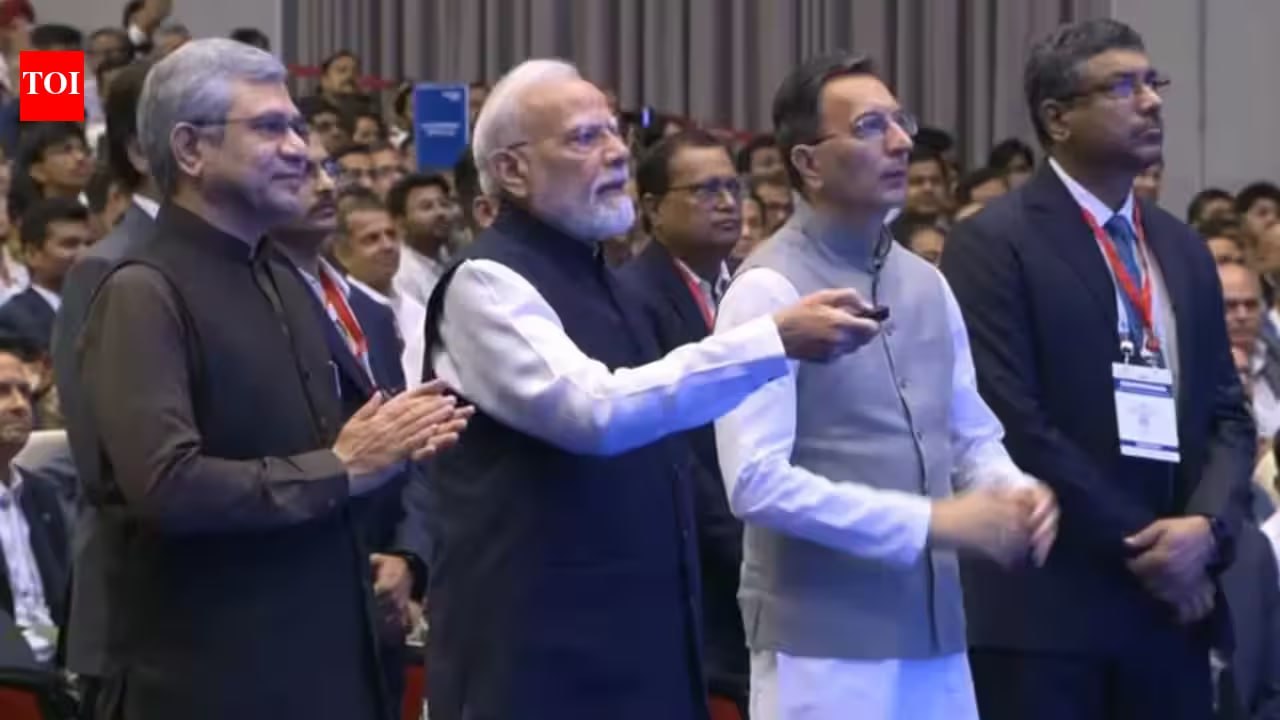
Vikram-1, built by Hyderabad-based Skyroot Aerospace, reached orbit on its very first attempt from the First Launch Pad at the Satish Dhawan Space Centre. ISRO recorded liftoff at 12:05:30 p.m. IST; roughly fifteen minutes later the vehicle had placed its payloads in a low Earth orbit of about 450 km at an inclination near 60 degrees.
The launch was held from its original 11:30 a.m. slot — a delay of about 35 minutes, attributed in reporting to a technical issue detected during the final countdown. Maiden flights of new launch vehicles fail more often than they succeed. This one did not.
Background: what makes an orbital launch hard
The distinction that matters here is between reaching space and reaching orbit, and it is the distinction most aspirants get wrong.
Space, by the Kármán line convention, begins at about 100 km altitude. Skyroot's earlier Vikram-S flew on 18 November 2022 under Mission Prarambh — a single-stage solid suborbital rocket that reached a peak altitude in the high 80s of kilometres (Skyroot's own mission page records 88.8 km; the company's CEO was quoted at the time citing 89.5 km) before splashing down about 125 km downrange in the Bay of Bengal. It went up and came back.
Orbit is a different problem. To stay in orbit at low Earth altitudes a payload needs a horizontal velocity of roughly 7.8 km per second — about 28,000 km per hour. It is not the altitude that is expensive; it is the sideways speed. This is why launch vehicles pitch over shortly after liftoff and spend most of their burn accelerating nearly parallel to the surface. Escape velocity, the threshold for leaving Earth's gravity altogether, is about 11.2 km per second.
Why rockets have stages
Every kilogram of empty propellant tank that a rocket continues to carry is a kilogram it must keep accelerating. Staging solves this by discarding structural mass as soon as its propellant is spent. Vikram-1 uses four stages. The first three are solid motors — dense, storable, high-thrust, mechanically simple, but once ignited they cannot be throttled or shut down. The fourth is a liquid stage, which can be restarted and finely controlled.
That division of labour is deliberate. Solids get the vehicle out of the thick atmosphere fast. The liquid stage does the delicate work of circularising the orbit and releasing payloads at the right velocity vector.
Key facts and figures
| Particular | Detail |
|---|---|
| Vehicle | Vikram-1 (also written Vikram-I), named after Vikram Sarabhai |
| Developer | Skyroot Aerospace Private Limited, Hyderabad |
| Mission name | Aagaman ("arrival") |
| Launch date and time | 18 July 2026, 12:05:30 p.m. IST |
| Launch site | First Launch Pad, Satish Dhawan Space Centre, Sriharikota |
| Orbit achieved | About 450 km low Earth orbit, roughly 60 degrees inclination |
| Configuration | Four stages — three solid, one liquid (per ISRO) |
| Solid stages | Kalam-1200, Kalam-250, Kalam-100 |
| Fourth stage | Orbit Adjustment Module with 3D-printed Raman-1 hypergolic liquid engines |
| Structure | All-carbon-composite airframe |
| Diameter | 1.7 m |
| Payload to LEO | Up to 350 kg |
| Payload to Sun-synchronous orbit (500 km) | About 260 kg |
| Planned upgrade | Vikram-1U with strap-on boosters, about 550 kg |
| Payloads flown | Six, including SCOPE (Skyroot) and SOLARAS S3 (Grahaa Space) |
| Company founded | 12 June 2018, by Pawan Kumar Chandana and Naga Bharath Daka |
| Previous flight | Vikram-S, suborbital, 18 November 2022 (Mission Prarambh) |
Two points where sources differ
Stage count. A few outlets described Vikram-1 as a "three-stage" or simply "multi-stage" vehicle. ISRO's own press note settles it: Vikram-1 "was developed as a 4-stage rocket with 3 solid stages and a liquid stage". The confusion arises because the fourth stage is a small orbital adjustment module rather than a conventional propulsive stage. Write four.
Height. Published figures range from about 20 m to 24 m; The Hindu and Skyroot's own communications describe the vehicle as "seven-storey". The diameter of 1.7 m is consistent across sources. If you need to state a height in an answer, say "roughly 20 to 24 metres, commonly described as seven storeys" rather than committing to a single figure.
Detailed explainer: the mission and the machine
What flew
Mission Aagaman carried six payloads. ISRO's account draws a distinction worth preserving: SCOPE, Skyroot's own satellite, and Grahaa Space's satellite (SOLARAS S3) were injected into low Earth orbit as free-flying spacecraft. The remaining payloads stayed attached to the upper stage to conduct in-orbit experiments. Saying "six satellites were deployed" would be inaccurate.
- SCOPE — Skyroot Aerospace's own satellite.
- SOLARAS S3 — a nanosatellite from Grahaa Space.
- Embrace — Cosmoserve Space's soft-robotic arm experiment aimed at capturing orbital debris.
- uD3PP and mD3RN — technology demonstrations from Germany's DCUBED.
- Cosmic Bloom — a floral artwork by Cosmos Diamonds, made with lab-grown diamond.
- Micro-art tribute — an 18-karat gold micro-rocket carrying microscopic sculptures of C.V. Raman, Vikram Sarabhai and A.P.J. Abdul Kalam, each smaller than a grain of rice.
The flight also carried a handwritten postcard from Prime Minister Narendra Modi bearing the words "Vande Mataram", alongside postcards from engineers, scientists and Indian astronauts. Symbolic cargo, but symbolism is part of what a first flight is for.
The manufacturing story
Two technical choices deserve attention because they are the actual competitive proposition, not the launch itself.
All-carbon-composite airframe. Replacing aluminium alloys with carbon composites cuts structural mass sharply. In a launch vehicle, structural mass is payload mass you did not get to sell. A lighter airframe at the same propellant load means either more payload or more margin.
3D-printed engines. The Raman-1 engines in the Orbit Adjustment Module are additively manufactured. The gain is not novelty. It is that printing an engine as a near-single piece removes joints and welds — which are where leaks and failures originate — and compresses manufacturing lead times from months to weeks. For a company whose business model depends on launch cadence rather than one prestige flight a year, that lead time is the whole game.
What the state actually provided
This is where the policy story lives, and ISRO's press note is unusually specific about it.
- ISRO gave Skyroot access to the solid motor casting and static test facilities at SDSC, Sriharikota. The first-stage solid motor was cast and tested there; the second-stage motor was also validated at the static test facility.
- ISRO supported vehicle stage preparation, material handling, transport of stages to the launch pad, trajectory analysis and vehicle integration on the First Launch Pad.
- ISRO's safety team supervised Skyroot's operations at SDSC on a 24x7 basis.
- IN-SPACe, as the regulation and promotion agency, established the mechanism for non-governmental entities to access ISRO facilities, and provided technical consultancy, mission readiness reviews and launch clearances.
Read that list again. A private company reached orbit using state-owned casting facilities, a state-owned static test stand, a state-owned launch pad, state trajectory analysis and a state safety organisation. That is not a criticism — it is the correct model for a capital-intensive industry with a sovereign incumbent that already owns the infrastructure. But it should temper any account of this as a purely private achievement.
Multi-dimensional analysis
The policy dimension: reform sequencing worked
The chain runs like this. IN-SPACe was announced in 2020 as a single-window authorisation body. The Indian Space Policy 2023 then codified the roles: ISRO focuses on research, development and advanced missions; IN-SPACe authorises and promotes; NSIL commercialises; and non-governmental entities are permitted to build and operate launch vehicles, satellites and ground infrastructure across the value chain. In 2024, FDI norms were liberalised — up to 100% under the automatic route for manufacturing satellite components and sub-systems, up to 74% for satellite manufacturing and operation, and up to 49% for launch vehicles, associated systems and spaceports.
Six years from policy signal to orbital capability is fast for this industry. IN-SPACe Technical Director Rajesh Jothi was quoted saying the ecosystem has grown from five or six startups before the reforms to more than 400 companies across launch vehicles, satellites and downstream applications.
The strategic dimension
Launch capacity is national capacity. A country that can put small payloads into orbit on short notice can replace a lost satellite, deploy a surveillance constellation, or respond to a contingency without waiting for a foreign slot. ISRO's own manifest is dominated by large national missions; small commercial payloads compete for attention. A private small-lift vehicle adds surge capacity and responsiveness to the national system, which is a distinct strategic good from raw tonnage.
The economic dimension, honestly assessed
The global small-satellite launch market is real but crowded and unforgiving. Rocket Lab's Electron dominates the dedicated small-launch segment; SpaceX's Falcon 9 rideshare programme undercuts dedicated small launchers on price per kilogram by flying hundreds of smallsats at a time. Several well-funded small-launch startups worldwide have failed commercially despite reaching orbit.
Vikram-1's advantage is Indian cost structure and, potentially, cadence. Its constraint is that 350 kg to LEO is a narrow band, and the customers who want dedicated launches into specific orbits are a subset of the market. Skyroot has raised roughly USD 160 million to date at a reported valuation of about USD 1.1 billion, with investors including GIC and Temasek, and is developing a larger Vikram-2 capable of around 1,000 kg. One successful flight validates the engineering. It does not yet validate the business.
The regulatory gap
India still does not have a dedicated statutory space law. A draft Space Activities Bill was circulated for consultation in 2017 but was not enacted. Authorisation today rests on the Indian Space Policy 2023 and IN-SPACe's administrative framework rather than on primary legislation. As private launches multiply, questions of third-party liability, insurance, orbital debris responsibility and the allocation of obligations under the Outer Space Treaty and the Liability Convention — under which the launching State bears international liability regardless of who built the rocket — will need a statutory answer. This is the single most citable weakness in an otherwise strong reform story.
Comparative and global perspective
| Vehicle | Operator and country | Approximate payload to LEO |
|---|---|---|
| Vikram-1 | Skyroot Aerospace, India (private) | Up to 350 kg |
| SSLV | ISRO, India (state) | Around 500 kg to 500 km LEO |
| Agnibaan | Agnikul Cosmos, India (private) | Small-lift, configurable |
| Electron | Rocket Lab, United States/New Zealand (private) | Around 300 kg |
| Alpha | Firefly Aerospace, United States (private) | Around 1,000 kg class |
| PSLV | ISRO, India (state) | Medium-lift workhorse, around 1,750 kg to SSO |
| LVM3 | ISRO, India (state) | Around 8,000 kg to LEO; 4,000 kg to GTO |
The comparative lesson is about market structure, not engineering. The United States built its private launch sector through anchor government contracts — NASA and the Department of Defense bought launches from private providers, guaranteeing demand while the companies matured. China's commercial launch sector grew under heavy state direction and state customers. India has so far provided infrastructure access and regulatory clearance but not a comparable anchor procurement programme. Whether Indian private launchers survive the next five years may depend more on whether the government becomes a reliable customer than on any further technical achievement.
India's launch vehicle family, for revision
- SLV-3 — India's first satellite launch vehicle; placed Rohini into orbit in 1980.
- ASLV — Augmented Satellite Launch Vehicle, a developmental step in the late 1980s and early 1990s.
- PSLV — Polar Satellite Launch Vehicle, the workhorse; four stages alternating solid and liquid; the vehicle for Chandrayaan-1 and Mangalyaan.
- GSLV — Geosynchronous Satellite Launch Vehicle, with an indigenous cryogenic upper stage.
- LVM3 — the heaviest, used for Chandrayaan-3 and the OneWeb commercial launches.
- SSLV — Small Satellite Launch Vehicle, three solid stages plus a Velocity Trimming Module, designed for on-demand small-satellite launches.
Committee, court and expert views
ISRO Chairman V. Narayanan framed the launch in complementarity terms rather than competition: "It is encouraging to see Indian industry translating technological capability into launch capability, complementing our national space programme." He added that ISRO and IN-SPACe remain committed to working with industry partners to build a globally competitive space ecosystem. The word "complementing" is doing deliberate work — the official position is that private launchers add to, rather than substitute for, ISRO.
Indian Space Policy 2023 is worth quoting in substance in a Mains answer. It mandates IN-SPACe to function as the single-window agency for authorising space activities by both government entities and non-governmental entities, covering the establishment and operation of space objects, the launch and operation of launch vehicles including suborbital launches, and the establishment and operation of launch pads. It separately tasks NSIL with commercialising space technologies created through public expenditure.
Skyroot's founders. Pawan Kumar Chandana, an IIT Kharagpur mechanical engineering graduate who spent six years at the Vikram Sarabhai Space Centre working on projects including LVM3, co-founded the company with Naga Bharath Daka in June 2018. The founding team's ISRO lineage is not incidental — the private sector here is drawing directly on capability built by decades of public investment in human capital.
The sceptical view, held by several space-economy analysts, is that reaching orbit is the easier half. Sustaining a launch cadence of a dozen or more flights a year with reliability above 95%, at a price competitive with rideshare, is where most small-launch companies have failed. That critique is not a dismissal of the achievement; it is the correct next test.
Way forward
- Enact a Space Activities Act. Codify authorisation, third-party liability caps, mandatory insurance, orbital debris mitigation obligations and the indemnity relationship between the operator and the Union of India as launching State. Administrative authorisation under a policy document is inadequate once launch frequency rises and foreign payloads are routinely carried.
- Create anchor demand through committed government procurement. Commit a defined number of small-satellite launches per year — for defence surveillance constellations, disaster-management imaging, and NavIC augmentation — to competitively selected private providers on multi-year contracts. Infrastructure access without a demand guarantee leaves companies dependent on volatile commercial markets.
- Build a dedicated commercial launch complex. Private launches currently compete with the national programme for pads and range time at SDSC. The proposed spaceport at Kulasekarapattinam in Tamil Nadu, oriented for southward small-satellite launches, should be prioritised so cadence is not constrained by ISRO's own manifest.
- Price and formalise ISRO facility access. Publish a transparent tariff and booking schedule for casting bays, static test stands and range services, so smaller entrants without Skyroot's funding can plan around known costs rather than negotiating case by case.
- Invest in the downstream, where the money actually is. Launch is a small fraction of global space revenue; applications — Earth observation analytics, satellite communications, precision agriculture, geospatial services — are the bulk. Liberalising launch while leaving data and geospatial policy restrictive would capture the least profitable segment of the value chain.
- Institutionalise debris responsibility now. Cosmoserve's Embrace debris-capture experiment on this very flight signals where the problem is heading. Mandate end-of-life deorbit plans as a condition of IN-SPACe authorisation before the domestic constellation population grows.
Static and current linkage
- NCERT Class 11, Physics: gravitation — orbital velocity, escape velocity, satellites and their energy; laws of motion and the principle of rocket propulsion.
- NCERT Class 11, India: Physical Environment / Class 12 Geography: remote sensing, satellite imagery and GIS applications.
- Shankar IAS / standard science and technology material: Indian space programme, launch vehicle families, types of orbits, satellite applications.
- Indian Space Policy 2023: roles of ISRO, IN-SPACe, NSIL and non-governmental entities.
- International space law: Outer Space Treaty (1967), Rescue Agreement (1968), Liability Convention (1972), Registration Convention (1975), Moon Agreement (1979 — India has signed but not ratified).
- Economic Survey and Budget documents: Department of Space allocations; the venture capital fund announced for the space sector.
- History of Indian science: Vikram Sarabhai, Homi Bhabha, INCOSPAR (1962), Thumba Equatorial Rocket Launching Station (first sounding rocket 1963), ISRO's formation in 1969.
Prelims pointers
- Vikram-1 is developed by Skyroot Aerospace, headquartered in Hyderabad, Telangana.
- Mission name: Aagaman, meaning "arrival".
- Launch date: 18 July 2026; liftoff recorded by ISRO at 12:05:30 p.m. IST.
- Launch site: First Launch Pad, Satish Dhawan Space Centre, Sriharikota, Andhra Pradesh.
- Orbit: about 450 km LEO at roughly 60 degrees inclination.
- Configuration per ISRO: four stages — three solid plus one liquid.
- Solid motors: Kalam-1200, Kalam-250, Kalam-100.
- Fourth stage: the Orbit Adjustment Module, using Raman-1 3D-printed hypergolic liquid engines.
- Structure: all-carbon-composite; diameter 1.7 m.
- Payload: up to 350 kg to LEO; about 260 kg to a 500 km Sun-synchronous orbit.
- Planned upgrade: Vikram-1U with strap-on boosters, about 550 kg.
- ISRO said SCOPE and Grahaa Space's satellite were injected into LEO; other payloads remained with the upper stage.
- Embrace (Cosmoserve Space) is a soft-robotic arm experiment for capturing orbital debris.
- Cosmic Bloom is a lab-grown diamond artwork by Cosmos Diamonds.
- Skyroot was founded on 12 June 2018 by Pawan Kumar Chandana and Naga Bharath Daka, both former ISRO engineers.
- Vikram-S, a single-stage solid suborbital rocket, flew on 18 November 2022 under Mission Prarambh.
- Both Vikram-S and Vikram-1 are named after Vikram Sarabhai, regarded as the father of the Indian space programme.
- IN-SPACe = Indian National Space Promotion and Authorisation Centre; the single-window authorisation body.
- NSIL = NewSpace India Limited, the PSU under the Department of Space that commercialises space technologies.
- The Indian Space Policy 2023 is the overarching framework for private participation.
- FDI in the space sector (2024): up to 100% automatic for components and sub-systems; up to 74% for satellite manufacturing and operation; up to 49% for launch vehicles and spaceports.
- Orbital velocity at LEO is about 7.8 km/s; escape velocity from Earth is about 11.2 km/s.
- A Sun-synchronous orbit is near-polar, around 98 degrees inclination, giving a constant local solar time at the ground track.
- Geostationary orbit lies at about 35,786 km above the equator, with a period of 24 hours.
- ISRO's own small-satellite vehicle is the SSLV; Agnikul Cosmos is developing Agnibaan.
- ISRO Chairman at the time of the launch: V. Narayanan.
Mains linkage
Probable question 1 (GS-3, 15 marks): "The successful orbital flight of a privately built Indian launch vehicle is as much a policy achievement as a technological one. Examine."
Skeleton: The launch facts in two lines → the reform chain: IN-SPACe (2020), Indian Space Policy 2023, FDI liberalisation 2024 → the concrete state contribution (casting and static test facilities, First Launch Pad, trajectory analysis, safety cover, mission readiness reviews) → what the technology itself contributed (carbon composites, 3D-printed engines, cadence-oriented design) → the remaining policy gap: no statutory space law, no anchor procurement → judgement. Keywords: single-window authorisation, non-governmental entities, launching State liability, anchor demand, launch cadence.
Probable question 2 (GS-3, 15 marks): "Private participation in India's space sector has expanded access but not yet altered market structure. Critically analyse."
Skeleton: Growth of the ecosystem from a handful of startups to over 400 firms → dependence on ISRO infrastructure and clearances → the global small-launch market's brutal economics, including rideshare price competition → the absence of committed government procurement compared with the US model → downstream applications as the larger revenue pool → recommendations. Keywords: anchor customer, value chain, rideshare, downstream applications, geospatial policy.
Probable question 3 (GS-3, 10 marks): "Discuss the legal and regulatory challenges arising from the growth of private space launch activity in India."
Skeleton: Outer Space Treaty 1967 and state responsibility for national activities → Liability Convention 1972 and the launching State's absolute liability for surface damage → India's lack of a Space Activities Act; the 2017 draft bill not enacted → issues: insurance, indemnity, debris mitigation, spectrum, foreign payloads, dual-use technology → way forward.
Mains practice question with model answer structure
Q. "Reaching orbit was the easy part." Critically examine this assessment of India's private launch sector in the light of the Vikram-1 mission. (250 words, 15 marks)
Introduction (about 30 words): State the fact — Vikram-1 reached a 450 km orbit on 18 July 2026, the first orbital-class vehicle built by an Indian private company — and frame the question as one about sustainability rather than capability.
Body — Why the achievement is substantial (about 70 words): Maiden orbital flights frequently fail; Vikram-1 succeeded first time. Genuine indigenous engineering in the all-carbon-composite airframe and 3D-printed Raman-1 engines. Validates the reform sequence from IN-SPACe to the Indian Space Policy 2023. Expands national surge capacity for small payloads independent of ISRO's crowded manifest.
Body — Why the harder part remains (about 80 words): Commercial viability requires cadence and reliability, not a single flight; global small-launch economics are punishing, with Falcon 9 rideshare undercutting dedicated launchers on price per kilogram. Heavy dependence on ISRO's casting, static test and launch infrastructure. No statutory space law; liability rests on the launching State under the 1972 Convention. No anchor government procurement of the kind that built the US private launch industry.
Body — Balanced judgement (about 40 words): The claim understates the engineering, which is genuinely hard, but correctly identifies where failure is most likely. Technology risk has been retired; market and regulatory risk have not.
Conclusion (about 30 words): Enact a Space Activities Act, commit multi-year launch procurement, and accelerate the dedicated commercial spaceport — so that Aagaman becomes an industry rather than an anniversary.
Key terms glossary
- Orbital-class launch vehicle: a rocket capable of imparting the horizontal velocity needed for a payload to remain in orbit, as distinct from a suborbital rocket that merely reaches space and falls back.
- Staging: discarding spent propellant tanks and motors during ascent so the vehicle stops accelerating structural mass it no longer needs.
- Orbit Adjustment Module (OAM): Vikram-1's restartable liquid fourth stage, used for precise orbital insertion and multi-orbit payload release.
- Hypergolic propellant: a fuel and oxidiser combination that ignites on contact without an ignition system, valued for reliability in restartable upper stages.
- Low Earth Orbit (LEO): orbits roughly between 160 km and 2,000 km altitude, used for Earth observation, communications constellations and human spaceflight.
- Sun-synchronous orbit (SSO): a near-polar orbit, around 98 degrees inclination, in which the satellite crosses a given latitude at the same local solar time each pass.
- Geostationary orbit (GEO): a circular equatorial orbit at about 35,786 km where the orbital period matches Earth's rotation, so the satellite appears fixed overhead.
- Geosynchronous Transfer Orbit (GTO): a highly elliptical intermediate orbit from which a satellite raises itself to GEO.
- Additive manufacturing: 3D printing; building components layer by layer, allowing near-single-piece engines with fewer joints and shorter lead times.
- Launch cadence: the frequency at which an operator can conduct launches — the decisive commercial variable in the small-launch market.
- Non-governmental entity (NGE): the term used in the Indian Space Policy 2023 for private and non-state actors authorised to undertake space activities.
- Launching State: under the Outer Space Treaty and Liability Convention, the state that launches or from whose territory a launch occurs, which bears international liability for damage caused.
Quick revision summary
- Vikram-1 lifted off on 18 July 2026 at 12:05:30 p.m. IST from the First Launch Pad, SDSC Sriharikota.
- Mission name: Aagaman, meaning 'arrival'. Vehicle named after Vikram Sarabhai.
- Reached approximately 450 km low Earth orbit at about 60 degrees inclination.
- Launch was held from the original 11:30 a.m. slot, a delay of roughly 35 minutes.
- ISRO describes it as a four-stage rocket: three solid stages plus a liquid stage.
- Solid stages: Kalam-1200, Kalam-250, Kalam-100. Fourth stage: Orbit Adjustment Module with 3D-printed Raman-1 engines.
- All-carbon-composite airframe; diameter 1.7 m; described as seven storeys tall.
- Payload capacity: up to 350 kg to LEO and about 260 kg to a 500 km Sun-synchronous orbit.
- Six payloads flown; ISRO said SCOPE (Skyroot) and Grahaa Space's satellite were injected into LEO.
- Other payloads: Cosmoserve's Embrace debris-capture arm, DCUBED demonstrations, Cosmos Diamonds' 'Cosmic Bloom', an 18-karat gold micro-art tribute, and a handwritten postcard from PM Modi.
- ISRO provided solid motor casting and static test facilities at SDSC; IN-SPACe provided authorisation, mission readiness reviews and launch clearance.
- Skyroot was founded on 12 June 2018 in Hyderabad by ex-ISRO engineers Pawan Kumar Chandana and Naga Bharath Daka.
- Skyroot's suborbital Vikram-S flew on 18 November 2022 under Mission Prarambh.
- An upgraded Vikram-1U with strap-on boosters is planned to lift about 550 kg.
- Enabling policy: Indian Space Policy 2023; FDI up to 49% under the automatic route for launch vehicles and spaceports.
Frequently asked questions
Is Vikram-1 a three-stage or a four-stage rocket?
Four. ISRO's own statement is explicit: Vikram-1 was developed as a four-stage rocket with three solid stages and a liquid stage. Some early reports described it as three-stage because the three solid stages do the bulk of the ascent, with the fourth being a small liquid Orbit Adjustment Module. For the exam, follow ISRO: four stages.
What does 'orbital-class' mean and why does it matter?
An orbital-class vehicle can impart enough velocity — roughly 7.8 km per second at low Earth orbit altitudes — for a payload to keep falling around the Earth rather than back onto it. Skyroot's 2022 Vikram-S was suborbital: it went up to about 89 km and came back down. Reaching orbit is a fundamentally harder engineering problem than reaching space.
What is the Orbit Adjustment Module?
The fourth stage of Vikram-1, powered by a cluster of Raman-1 liquid engines that are 3D-printed and use hypergolic propellants. Because a liquid engine can be throttled and restarted while a solid motor cannot, the OAM allows precise orbital insertion and the ability to place multiple satellites into slightly different orbits on a single flight.
Did ISRO help a private company? Doesn't that defeat the point?
ISRO and IN-SPACe provided extensive handholding, and that is by design, not an anomaly. ISRO gave access to solid motor casting and static test facilities at SDSC, where the first-stage motor was cast and tested and the second-stage motor validated. It also supported stage preparation, transport, trajectory analysis and vehicle integration on the First Launch Pad, with a safety team on duty round the clock. The Indian Space Policy 2023 explicitly mandates IN-SPACe to enable non-governmental entities to access ISRO facilities.
Is India really the third country with private orbital launch capability?
That is how the achievement was widely reported — after the United States and China. Treat the claim as reported rather than as a formal international classification, because the category depends on definitions such as whether a company is nationally owned, where it launches from, and how 'private' is defined. What is uncontested is that Vikram-1 was the first orbital-class launch vehicle designed, developed and integrated by an Indian private company.
What is IN-SPACe and how is it different from NSIL?
IN-SPACe, the Indian National Space Promotion and Authorisation Centre, is an autonomous single-window agency that authorises, promotes and hand-holds space activities by government and non-governmental entities, and enables access to ISRO facilities. NewSpace India Limited is a public sector undertaking under the Department of Space, responsible for commercialising space technologies created through public expenditure and providing launch services on commercial terms. Regulator-promoter versus commercial arm.
How does Vikram-1 compare with ISRO's SSLV?
Both target the small-satellite market. SSLV is ISRO's own three-stage solid vehicle with a Velocity Trimming Module, designed for around 500 kg to a 500 km low Earth orbit. Vikram-1 is rated at up to 350 kg to LEO. They are competitors in the same segment, which is why ISRO's decision to transfer SSLV technology to industry and Skyroot's independent development are two tracks of the same policy.
Why was the orbit at 60 degrees inclination rather than Sun-synchronous?
Sun-synchronous orbits are near-polar, around 98 degrees, and are the standard for Earth-observation satellites. A 60 degree inclination is a mid-inclination low Earth orbit. For a maiden demonstration flight carrying technology payloads rather than an operational Earth-observation constellation, the choice reflects trajectory, range-safety and performance considerations rather than a mission requirement for repeat ground-track imaging.
What should I write about this in a Mains answer?
Do not write a launch report. Write about what the launch proves: that a policy reform sequence beginning with IN-SPACe in 2020 and the Indian Space Policy 2023, combined with state-provided test infrastructure, produced a private orbital capability in six years. Then be honest about what it does not prove — one successful flight is not a commercial launch business, and India still lacks a statutory space law.
Related current affairs articles
- Project Kusha LR-SAM: DRDO Air Defence Test 2026
- APAAR ID Explained: One Nation One Student ID
- Investment Friendliness Index 2026: Gujarat Tops
Sources
- [Primary] Indian Space Research Organisation, “First private orbital launch lifts off from Sriharikota”, 18 July 2026. Link
- [Primary] Press Information Bureau, Government of India, “Vikram-1: Charting India's Cosmic Future”, July 2026. Link
- The Hindu, “Vikram-1, country's first private orbital-class rocket, successfully places tech payloads, postcards into orbit”, 18 July 2026. Link
- Via Satellite, “Skyroot Aerospace Makes History for India With First Launch Success”, 20 July 2026. Link
- [Primary] Prime Minister of India / Cabinet, “Cabinet approves amendment in the Foreign Direct Investment (FDI) policy on Space Sector”, 21 February 2024. Link