DailyGS2medium

Literacy for All: India’s Journey Towards Viksit Bharat

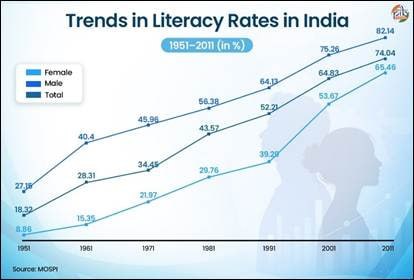
The literacy rate in India increased from 18.32 per cent in 1951 to 81.1 per cent in PLFS 2025. Issues of adult literacy and foundational learning are addressed by NEP 2020, ULLAS, and NIPUN Bharat. Yet there are disparities on the basis of region, gender, and the digital divide. India needs to go beyond just literacy towards competence and learning.

30 Sept 2026 4 min read 12 views
Literacy for All: India’s Journey Towards Viksit Bharat

Quick Revision

Why in news: The Press Information Bureau (PIB) emphasised how far India has come in ensuring literacy in the country, pointing out the gradual increase in literacy rates since Independence as well as the various interventions from the government to help achieve literacy. According to recent data, the literacy rate in India is 81.1% according to PLFS 2025, while efforts like ULLAS, NIPUN Bharat, Samagra Shiksha, and PM e-Vidya address adult illiteracy and foundational learning issues.

Background

  • At Independence, India faced widespread illiteracy, particularly among women, rural communities and socio-economically disadvantaged groups.

  • India’s literacy rate increased from 18.32% in 1951 to 74.04% in 2011.

  • Female literacy witnessed a particularly significant improvement, rising from 8.86% in 1951 to 65.46% in 2011.

  • The National Education Policy (NEP) 2020 places strong emphasis on:

    • Foundational Literacy and Numeracy (FLN)

    • Adult education and lifelong learning

    • Universal access to quality education

    • Reduction of educational inequalities.

  • The government considers 95% literacy in a State/UT as equivalent to full literacy.

  • India’s literacy agenda is closely linked with SDG 4, which seeks to ensure inclusive and equitable quality education and promote lifelong learning opportunities for all.

Features

ULLAS – Adult Literacy

  • ULLAS (Understanding of Lifelong Learning for All in Society), also known as the New India Literacy Programme (NILP), focuses on adults aged 15 years and above who did not receive adequate formal schooling.

It covers:

  • Foundational literacy and numeracy

  • Critical life skills

  • Vocational skills

  • Basic education

  • Continuing education

  • Lifelong learning

The programme adopts a volunteer-based and Janbhagidari approach, involving citizens as volunteers and learners.

  • Target: 5 crore learners during 2022–27.

NIPUN Bharat – Foundational Learning

NIPUN Bharat stands for National Initiative for Proficiency in Reading with Understanding and Numeracy.

  • Launched in July 2021 under Samagra Shiksha.

  • Focuses on children in the Foundational Stage (3–8 years).

  • Objective: Achieve universal foundational literacy and numeracy by 2026–27.

  • Emphasis is on ensuring that children acquire basic reading, writing and numeracy skills by Grade 2.

Thus, ULLAS addresses adult literacy, whereas NIPUN Bharat focuses on foundational learning among young children.

Supporting Initiatives

Other programmes complement the literacy mission:

  • Samagra Shiksha: Integrated scheme for school education from pre-school to Class XII.

  • PM SHRI: Development of more than 14,500 exemplar schools.

  • PM e-VIDYA: Digital, online and on-air learning initiatives.

  • PM POSHAN: Nutritional support through hot cooked meals for eligible schoolchildren.

Challenges

Regional disparities

  • Literacy levels differ considerably across States/UTs and rural-urban areas.

Gender gap

  • Although the female literacy rate has increased substantially, gender disparities in educational access and outcomes continue in some regions.

Quality versus mere literacy

  • Being able to read and write does not necessarily imply functional literacy. Learning outcomes and comprehension remain important.

Foundational learning deficit

  • Children may attend school but fail to acquire age-appropriate reading and numeracy skills, making NIPUN Bharat particularly important.

Adult illiteracy

  • Adults who missed formal schooling may face difficulties in accessing digital services, financial systems, government schemes and employment opportunities.

Digital divide

  • Differences in access to devices, internet connectivity and digital skills can reinforce existing educational inequalities.

Social and economic barriers

  • Poverty, migration, child labour, inadequate infrastructure and social norms can adversely affect educational participation and retention.

Way Forward

Shift from literacy to learning

  • Policy should focus not merely on literacy percentages but on measurable reading comprehension, numeracy and functional skills.

Strengthen foundational education

NIPUN Bharat should be supported through:

  • Better teacher training

  • Local-language learning material

  • Early childhood education

  • Continuous assessment

  • Remedial learning.


Expand adult education

  • ULLAS can be strengthened through community-based learning centres, volunteers, NGOs and local institutions.

Bridge the digital divide

Greater investment is required in:

  • Internet connectivity

  • Affordable devices

  • Digital literacy

  • Multilingual educational content.

Focus on disadvantaged groups

  • Special attention should be given to women, tribal communities, persons with disabilities, migrants and economically disadvantaged households.

Improve data-driven monitoring

  • Regular assessment of learning outcomes, rather than enrolment alone, should guide policy interventions.

Promote lifelong learning

  • Literacy should be connected with vocational skills, financial literacy, digital literacy, health awareness and employment opportunities.

Conclusion

India has made remarkable progress in the domain of literacy since its Independence, with an increase in the literacy rate from 18.32 per cent in 1951 to 74.04 per cent in 2011 and achieving 81.1 per cent, as per PLFS 2025. Nevertheless, universal literacy is more than an increase in the literacy rate. The dual strategy of ULLAS and NIPUN Bharat, facilitated by NEP 2020 and other educational programs, aims to bring about universal learning for India.
UPSC Prelims Facts

Term: Literacy for All — India's Journey Towards Viksit Bharat

Meaning: India's progress from 18.32% literacy in 1951 to 81.1% (PLFS 2025), with NEP 2020, ULLAS (adult literacy for ages 15+, target 5 crore learners by 2022–27) and NIPUN Bharat (foundational literacy and numeracy for ages 3–8 by 2026–27) addressing adult illiteracy and foundational learning, while disparities of region, gender and digital divide persist and the focus must shift from mere literacy to competence and learning.

Related: PLFS 2025, NEP 2020, ULLAS/NILP, NIPUN Bharat, Samagra Shiksha, PM SHRI, PM e-VIDYA, PM POSHAN, SDG 4, Foundational Literacy and Numeracy (FLN), 95% literacy benchmark, Janbhagidari, female literacy (8.86% in 1951 to 65.46% in 2011).

Core Themes: From literacy to learning and functional skills; foundational learning deficit; adult illiteracy and lifelong learning; regional, gender and digital divides; social and economic barriers like poverty, migration and child labour; way forward through measurable learning outcomes, stronger foundational education, expanded adult education, bridging the digital divide, focus on disadvantaged groups, data-driven monitoring and linking literacy to vocational, financial and digital skills.

Prelims angle

Focus on key facts, terms and institutions mentioned above.

Mains angle

Link to relevant GS themes and frame analytical points.

Syllabus: Social Issues, Governance

Download notes

Daily Current Affairs - 30 September 2026

Free download · 20 downloads

Test yourself

Daily Current Affairs Quiz - 30 September 2026

Practice the related MCQs now.

Attempt the quiz
Free resource

Get free monthly Current Affairs PDF

Join thousands of aspirants. We'll send the compilation to your WhatsApp.

No spam. Unsubscribe anytime.

More from Current Affairs

Women’s Safety: Bridging the Gap Between Policy and Action
Daily Important
Polity & GovernancePrelims + Mains

Women’s Safety: Bridging the Gap Between Policy and Action

The Nirbhaya Fund, women’s helplines, special courts, and safety audits post-2012 are some of the mechanisms that have been put in place to make India’s institutions more conducive to the security of women. Nevertheless, there is still disjointed governance, poor accountability, inadequate infrastructure, and lack of outcomes measurement. Policies in the future should ensure outcomes, accountability, gender-sensitive urban development, and increased involvement of women.

29 Sept 2026 3 min
Daily Important
Polity & GovernancePrelims + Mains

India’s NGOs at a New Funding Crossroads

The draft FCRA Amendment Bill 2026 proposes provisional vesting and disposal of assets of deregistered NGOs, raising concerns over financial autonomy, welfare institution disruption, and civil society space. Balancing national security and transparency with legitimate charitable activity is essential. Way forward: clear asset rules, funding diversity through domestic philanthropy, CSR, retail giving, and stakeholder consultation.

21 Sept 2026 4 min
Implementing ₹24,000-crore scheme to modernise police, Centre tells Supreme Court
Daily Important
Polity & GovernancePrelims + Mains

Implementing ₹24,000-crore scheme to modernise police, Centre tells Supreme Court

Centre announces ₹24,000-crore Police Modernisation Mission over five years for State and Central police forces. Supreme Court was informed amid concerns over non-functional CCTV cameras. Challenges: fund underutilisation, maintenance gaps, manpower shortage, and lack of police reforms. Success depends on outcome-based funding, lifecycle maintenance, reforms, and citizen-centric accountability.

4 Sept 2026 3 min