Managing the China Relationship
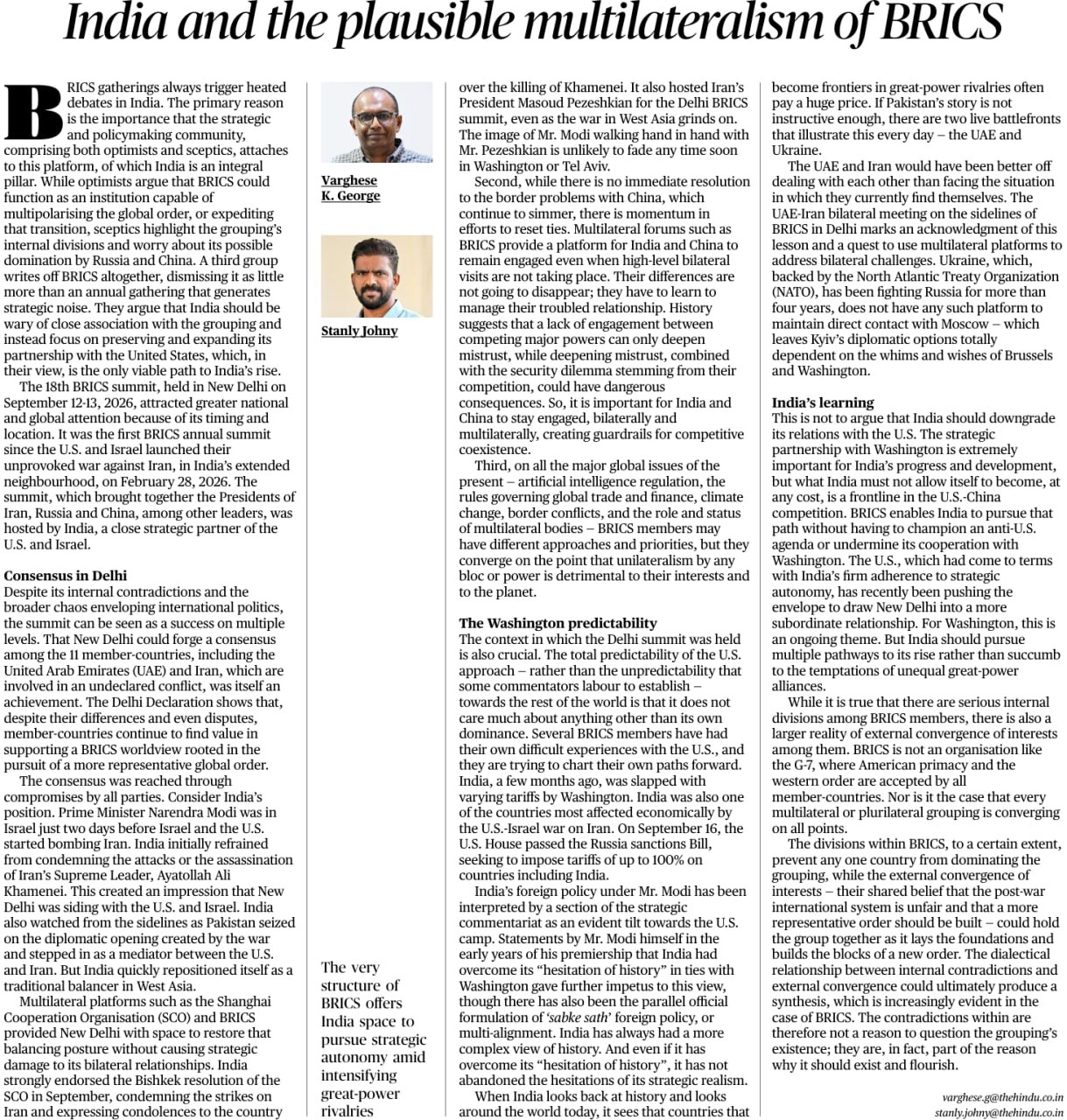
The India-China border dispute remains unresolved and continues to simmer. But there is momentum toward resetting ties, and multilateral forums like BRICS let India and China stay engaged even without high-level bilateral visits.
The underlying logic: a lack of engagement between competing major powers deepens mistrust, and mistrust combined with a security dilemma can turn dangerous.
Staying engaged - bilaterally and multilaterally — creates guardrails for competitive coexistence.
Convergence Despite Divergence
On major global issues - AI regulation, global trade and finance rules, climate change, border conflicts, and the status of multilateral bodies - BRICS members hold different approaches and priorities.
Yet they converge on one point: unilateralism by any bloc or power harms their interests and the planet.
The “Washington Predictability”
Analysts frame US behaviour not as unpredictable, but as totally predictable in one sense - a consistent focus on its own dominance above all else.
Several BRICS members have had difficult direct experiences with this:
India was recently hit with varying US tariffs.
India was among the countries most economically affected by the US-Israel war on Iran.
On September 16, 2026, the US House passed the Russia sanctions Bill, threatening tariffs of up to 100% on countries including India.
India’s foreign policy under PM Modi has sometimes been read as a tilt toward the US camp, reinforced by his early remark that India had overcome its “hesitation of history” with Washington.
But this coexists with the official framing of “sabke saath” - multi-alignment.
Experts contend that India has not abandoned the hesitations of strategic realism, even if it shed historical hesitancy.
The Lesson of Frontline States
History and current events both warn against becoming a frontline in great-power rivalry.
Pakistan’s experience is one instructive example.
UAE and Iran — better off dealing with each other directly — found a partial corrective through their bilateral meeting on the sidelines of the Delhi BRICS summit, using a multilateral platform to address a bilateral problem.
Ukraine, by contrast, backed by NATO and fighting Russia for over four years, has no direct platform to engage Moscow, leaving its diplomatic options entirely dependent on Brussels and Washington.
Feature
BRICS as a vehicle for multipolarity
BRICS members broadly favour a global system in which international power is distributed among several centres rather than dominated by a single power.
For India, this supports its long-standing objective of strategic autonomy.
Internal contradictions
BRICS is not a homogeneous bloc.
Major differences exist over:
India–China border tensions
Russia–West confrontation
Middle Eastern rivalries
Different approaches to trade and investment
Relations with the United States
Security and geopolitical priorities
External convergence
Greater representation for developing countries
Reform of the UN and other global institutions
Greater voice for the Global South
More balanced international financial architecture
Opposition to unilateral approaches to international affairs
Cooperation on climate, technology and development
Challenges
China–India strategic rivalry
China's economic and military weight gives it considerable influence within BRICS.
For India, the challenge is to participate in BRICS without allowing the platform to become dominated by any single member.
Divergent geopolitical interests
The expansion of BRICS has brought together countries with very different foreign-policy objectives.
Therefore, reaching consensus on contentious security issues can be difficult.
Limited institutionalisation
BRICS does not function like a traditional treaty-based alliance or organisation with a strong permanent bureaucracy.
Its effectiveness depends substantially on consensus and political willingness.
Risk of becoming anti-Western
India does not view BRICS simply as an anti-U.S. grouping.
New Delhi simultaneously maintains important partnerships with the United States, Europe, Japan, Australia and other countries.
An excessively anti-Western orientation could therefore constrain India's strategic autonomy.
Implementation gap
Declarations on reforming global governance are easier to make than to implement.
BRICS needs to convert political consensus into institutional reforms, financial mechanisms, trade facilitation, technology cooperation, and development projects.
India's Strategic Significance
For India, BRICS provides several diplomatic advantages: Strategic autonomy → Multi-alignment → Multiple partnerships → Greater negotiating space
India can simultaneously:
cooperate with the U.S. on technology, defence and Indo-Pacific issues;
engage Russia on energy, defence and strategic matters;
manage competition with China;
engage countries of the Global South;
use BRICS, SCO, G20 and other forums to advance its interests.
This is consistent with India's broader approach of pursuing partnerships without entering into a rigid alliance system.
India's 2026 BRICS chairship itself emphasises resilience, innovation, cooperation and sustainability, while the BRICS Young Diplomats Forum has focused on political-security, economic-financial and cultural cooperation.
Way Forward
Strengthen issue-based cooperation
BRICS should concentrate on areas where consensus is possible: trade and investment, development finance, climate change, health, food and energy security, digital technology, artificial intelligence, and scientific cooperation
Maintain strategic autonomy
India should avoid turning BRICS into an anti-U.S. platform while also resisting pressure to become part of a rigid great-power bloc.
Institutional reform
stronger working mechanisms,
greater coordination among ministries,
improved implementation of summit commitments,
enhanced financial cooperation.
Manage India–China competition
Multilateral engagement should complement bilateral diplomacy by keeping communication channels open and reducing the risks arising from strategic mistrust.
Give greater voice to the Global South
BRICS can act as a platform through which developing countries seek greater representation in institutions such as:
UN Security Council
IMF
World Bank
WTO
What India Should Learn
The argument is not that India should downgrade ties with the US. The US partnership remains vital for India’s development.
But India must avoid becoming a frontline in the US-China competition. BRICS lets India pursue this path without championing an anti-US agenda or undermining cooperation with Washington.
Washington, having previously accepted India’s adherence to strategic autonomy, has reportedly been pushing to draw India into a more subordinate relationship.
India’s answer should be to pursue multiple pathways to its rise, rather than accept unequal great-power alliances.
Conclusion
While the significance of BRICS to India is less about the formation of another fixed geopolitical alliance and more about increasing its options in diplomacy, the problems within the group remain very much real, but they do not automatically render the group unproductive. Rather, the fact that countries with conflicting interests can collaborate on some chosen issues at a global level can also be regarded as a form of pragmatism in multilateralism.