Background
The Arbitration and Conciliation Act, 1996 provides the principal statutory framework for:
Domestic arbitration
International commercial arbitration
Conciliation
Enforcement of foreign arbitral awards.
Investor-State Dispute Settlement (ISDS) allows a foreign investor to bring certain claims directly against the host State through an international arbitration mechanism.
India has adopted a relatively cautious approach towards ISDS in its recent treaty practice, with several recent FTAs not containing conventional ISDS mechanisms.
At the same time, India’s recent BITs have sought to distinguish treaty-based investment disputes from ordinary contractual disputes between investors and State entities.
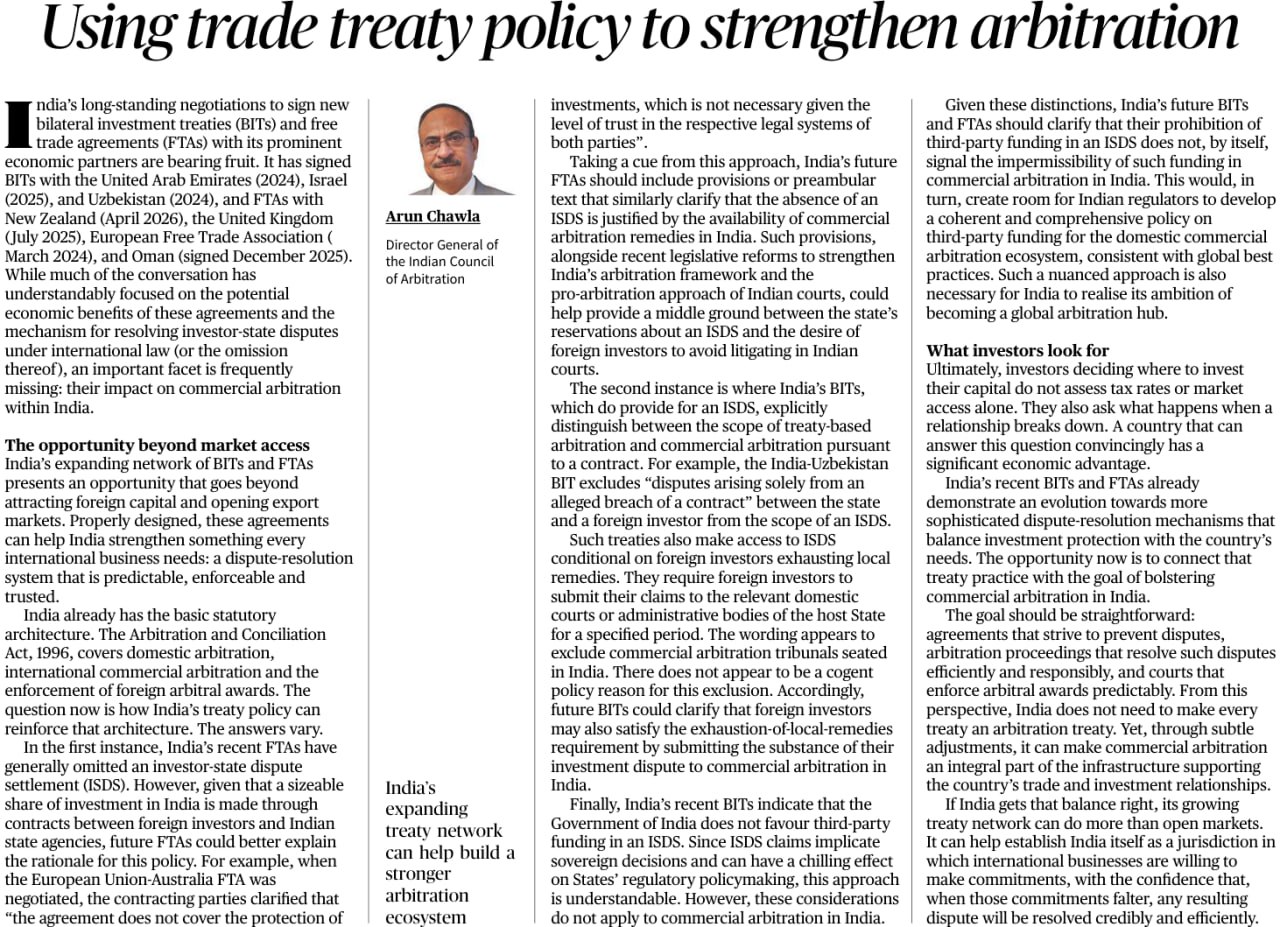
This creates an opportunity to use treaty language to strengthen commercial arbitration seated in India, rather than relying exclusively on international investment arbitration.
Opportunity Beyond Market Access
The Arbitration and Conciliation Act, 1996 provides the statutory foundation for domestic arbitration, international commercial arbitration and enforcement of foreign awards.
The challenge is to connect this framework more effectively with India’s international treaty policy.
India’s recent FTAs have generally omitted Investor-State Dispute Settlement (ISDS), reflecting concerns about regulatory autonomy and potential claims against the State.
However, substantial foreign investment occurs through contracts between investors and Indian government agencies.
In such cases, commercial arbitration can provide an alternative to ordinary court litigation.
Future FTAs could clarify that the absence of ISDS is supported by the availability of effective commercial arbitration remedies in India.
Such clarity would reassure investors while preserving India’s reservations concerning international investment arbitration.
Features
Linking FTAs with domestic commercial arbitration
Future FTAs could clarify that the absence of ISDS does not leave investors without effective remedies.
Treaties could recognise the availability of commercial arbitration in India.
This could provide a middle ground between:
India's reservations regarding extensive ISDS mechanisms, and
Foreign investors' concerns about relying entirely on domestic courts.
Distinguishing ISDS from commercial arbitration
Recent BITs distinguish between:
Treaty-based disputes
Arise from alleged violations of investment protections under the treaty.
May potentially fall within ISDS.
Contractual disputes
Arise from an alleged breach of a contract between a State entity and an investor.
May be dealt with through contractual/commercial arbitration.
For example, the India–Uzbekistan BIT excludes disputes arising solely from an alleged contractual breach from the treaty's ISDS mechanism.
Exhaustion of local remedies
Some BITs require investors to first approach domestic courts or administrative bodies before accessing ISDS.
A policy question arises over whether commercial arbitration in India should also qualify as a form of domestic remedy for this purpose.
The proposed approach is to allow investors to satisfy such requirements by submitting the substance of their dispute to an appropriate commercial arbitration mechanism in India.
Third-party funding
Third-party funding involves an outside party financing arbitration proceedings in return for a potential financial return.
India's recent BIT practice indicates caution regarding third-party funding in ISDS, because investment disputes can involve sovereign decisions and regulatory policy.
Therefore, treaty provisions could distinguish between:
restrictions on third-party funding in ISDS, and
its potential use in domestic commercial arbitration.
Distinguishing ISDS from Commercial Arbitration
India’s BITs increasingly distinguish treaty-based investment arbitration from contractual commercial arbitration.
The India-Uzbekistan BIT, for example, excludes disputes arising solely from contractual breaches from ISDS.
Greater clarity is required regarding local-remedy requirements. Some BITs require investors to approach domestic courts or administrative bodies before initiating international arbitration.
Commercial arbitration seated in India should potentially be recognised as another legitimate mechanism for addressing investment-related contractual disputes.
Future BITs could therefore clarify that pursuing a dispute through Indian commercial arbitration may satisfy applicable local-remedy requirements.
This would better integrate domestic arbitration into India’s investment-protection architecture while avoiding unnecessary procedural uncertainty.
Challenges
Investor confidence: Investors require certainty regarding how disputes will be resolved.
Overlap between treaty and contractual claims: Poorly drafted provisions may create uncertainty over whether a dispute falls under ISDS or commercial arbitration.
Local-remedy requirements: Ambiguous language could create procedural disputes regarding what constitutes exhaustion of remedies.
Third-party funding: India currently lacks a comprehensive and settled framework specifically governing third-party funding in commercial arbitration.
Enforcement: Arbitration becomes effective only when arbitral awards can be enforced efficiently and predictably.
Institutional capacity: India needs stronger arbitration institutions, specialised expertise and efficient procedures.
Court intervention: Excessive or unpredictable judicial intervention can undermine the advantages of arbitration.
Treaty coherence: BITs, FTAs and domestic arbitration law need to operate consistently rather than creating conflicting obligations.
Way Forward
Better treaty drafting
Future BITs and FTAs should clearly distinguish: ISDS, contractual disputes, commercial arbitration, and domestic judicial remedies.
Recognise Indian commercial arbitration as an effective remedy
Where appropriate, treaty provisions could clarify that approaching a commercial arbitration tribunal in India may satisfy applicable local-remedy requirements.
Develop a clear framework for third-party funding.
India could establish transparent rules dealing with: disclosure of funding, conflicts of interest, confidentiality, ethical obligations, and security for costs.
Ensure predictable judicial support
Courts should facilitate arbitration while limiting unnecessary intervention, particularly at the enforcement stage.
Improve coordination among institutions
The Central Government, State governments, arbitral institutions, courts and regulatory authorities should work towards a coherent arbitration ecosystem.
Conclusion
The increase in India’s BIT and FTA network opens up avenues for aligning trade policy, investment policy and dispute settlement policy. This need not necessarily mean the transformation of all treaties into arbitral agreements. On the contrary, properly formulated treaty terms can serve to enhance domestic commercial arbitration through the 1996 Arbitration and Conciliation Act.