DailyGS3medium

Chemistry Nobel for French-Japanese Duo: Mirrored Molecules

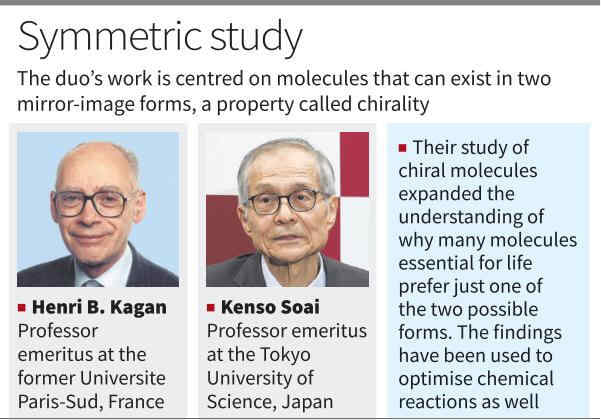
The 2026 Nobel Prize in Chemistry went to Henri Kagan and Kenso Soai for chirality research. Kagan showed tiny catalyst imbalances amplify into a strong preference for one molecular form; Soai demonstrated self-amplification of handedness. This enables asymmetric synthesis of single enantiomers, making medicines, agrochemicals and fragrances safer and more efficient.

8 Oct 2026 2 min read 0 views
Chemistry Nobel for French-Japanese Duo: Mirrored Molecules

Quick Revision

Why in news: Henri Kagan and Kenso Soai received the 2026 Nobel Prize in Chemistry for their studies on chirality and asymmetric chemistry reactions. This is due to the fact that their research proved the possibility of amplifying molecular asymmetry, which makes it possible for chemists to obtain one particular “hand” of a molecule. This is significant in that various medicines, agricultural chemicals and fragrances differ in effect according to their molecular handedness.

Background 

  • Key Concept

Chirality

  • Chiral molecules are molecules that exist in two forms that are mirror images of each other, similar to the left and right hands.

  • These two forms are called enantiomers.

  • Although they have the same chemical formula, they can interact differently with biological systems.

  • This happens because biological molecules such as enzymes, proteins and receptors are themselves chiral.

  • Therefore, one enantiomer of a drug may produce the desired therapeutic effect, while the other may be less effective or produce unwanted effects.

Contribution of Kagan

  • In 1986, Kagan and his team demonstrated that even a small imbalance in the handedness of a catalyst could lead to a much larger preference for one molecular form in the reaction products.

  • This provided an important basis for asymmetric synthesis—the production of predominantly one desired enantiomer.

Contribution of Soai

  • Nearly a decade later, Soai and colleagues demonstrated an important form of self-amplification.

  • A chiral molecule could promote the formation of more molecules having the same handedness.

  • This helped scientists understand how a tiny initial asymmetry could become strongly amplified.

Challenge

  • Producing a single desired enantiomer is chemically difficult because ordinary reactions often produce both mirror-image forms.

  • Separating the unwanted form after production can be expensive, inefficient and environmentally burdensome.

  • In pharmaceuticals, the wrong enantiomer can sometimes have different biological activity or undesirable effects.

  • A deeper scientific challenge is explaining how biological systems came to strongly favour one molecular handedness—for example, why biological amino acids predominantly occur in one configuration.

Way Forward

  • Develop more efficient chiral catalysts that selectively produce the desired enantiomer.

  • Apply asymmetric synthesis to the development of safer and more effective medicines.

  • Reduce the need for separation and purification of unwanted enantiomers, thereby lowering production costs and chemical waste.

  • Explore self-amplifying chemical reactions to better understand the origin of molecular asymmetry and the emergence of biological homochirality.

  • Use these principles in agrochemicals, materials, fragrances and fine chemicals.

Conclusion

The findings of Kagan and Soai show how a minute “left-right” difference at the molecular level can be manipulated to generate a significant chemical result. Through their findings, asymmetric chemistry has become an instrument rather than a tough job when it comes to creating molecular forms. The findings have not only practical value but also importance in the understanding of life processes.
UPSC Prelims Facts

Term: 2026 Nobel Prize in Chemistry - Chirality and Asymmetric Synthesis

Meaning: The 2026 Nobel Prize in Chemistry was awarded to Henri Kagan and Kenso Soai for their studies on chirality and asymmetric chemical reactions, proving that molecular asymmetry can be amplified-Kagan (1986) showed a small imbalance in a catalyst's handedness yields a much larger preference for one molecular form, while Soai demonstrated self-amplification where a chiral molecule promotes formation of more molecules of the same handedness-enabling chemists to obtain a single desired "hand" of a molecule.

Related: Chirality, enantiomers, asymmetric synthesis, chiral catalysts, self-amplification, biological homochirality, pharmaceuticals, agrochemicals, fragrances, fine chemicals, enzymes/proteins/receptors.

Core Themes: Mirror-image molecules (enantiomers) interacting differently with chiral biological systems; one enantiomer may be therapeutic while the other is ineffective or harmful; difficulty and cost of producing and separating single enantiomers; self-amplifying reactions explaining the origin of molecular asymmetry and biological homochirality; way forward through efficient chiral catalysts, safer medicines, reduced purification waste, and applications in agrochemicals, materials and fine chemicals.

Prelims angle

Focus on key facts, terms and institutions mentioned above.

Mains angle

Link to relevant GS themes and frame analytical points.

Syllabus: Science & Technology, Technology

Download notes

Daily Current Affairs - 08 October 2026

Free download

Test yourself

Daily Current Affairs Quiz - 07 October 2026

Practice the related MCQs now.

Attempt the quiz
Free resource

Get free monthly Current Affairs PDF

Join thousands of aspirants. We'll send the compilation to your WhatsApp.

No spam. Unsubscribe anytime.

More from Current Affairs