Background
Discovery
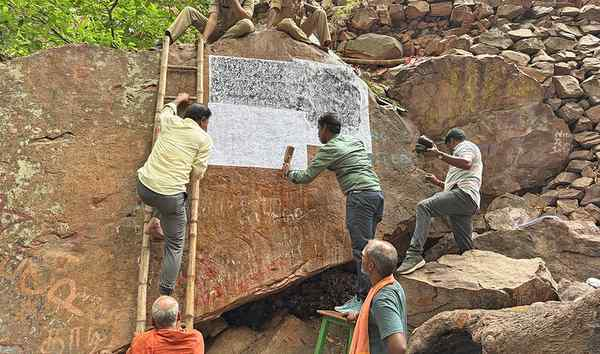
The inscriptions were found during an epigraphical survey in the Sadasivakona region of the Seshachalam Hills.
The survey was conducted by a team led by K. Muniratnam Reddy.
The inscriptions were copied using the estampage technique for preservation and scholarly analysis.
Key Findings
Written in Telugu, Tamil, and Kannada, reflecting the multilingual character of the Vijayanagara Empire.
Date to 1554 CE, during the reign of Sadasiva Deva Raya.
Record the construction of a Shiva temple and a monastery (mutt) at Papavinasa in Sadasivakona.
Mention the king's pilgrimage and donation to the sacred site.
About the Vijayanagara Empire
Vijayanagara Empire
Founded in 1336 by Harihara I and Bukka Raya I.
Served as a major political and cultural power in South India.
Promoted Hindu temple architecture, literature, trade, and irrigation.
Known for administrative efficiency and patronage of multiple languages.
Sadasiva Deva Raya
Nominal ruler from 1542–1570 CE.
Actual power was exercised largely by Aliya Rama Raya.
His reign witnessed both cultural patronage and increasing military challenges.
Connection with Gudimallam Temple
The discovery is especially significant because it sheds light on the historical importance of the nearby Gudimallam Parasurameswara Temple.
About Gudimallam Temple
Considered one of the oldest surviving Shiva temples in India.
Dates back to around the 2nd century BCE.
Famous for its unique Shiva Linga featuring an anthropomorphic representation of Lord Shiva.
Represents an important phase in the evolution of temple architecture and Shaivism.
Relevance of the Inscription
Suggests that the region retained religious significance even during the Vijayanagara period.
Indicates continued royal patronage and pilgrimage traditions.
Challenges
Heritage Conservation
Remote forest locations make monuments vulnerable to weathering and vandalism.
Limited Exploration
Large parts of the Seshachalam-Nallamala region remain archaeologically underexplored.
Documentation and Digitisation
Many inscriptions remain undocumented or poorly preserved.
Human and Environmental Threats
Encroachment, forest fires, and illegal activities can damage heritage sites.
Way Forward
Comprehensive Archaeological Surveys
Expand epigraphic and archaeological investigations in the Seshachalam and Nallamala regions.
Digital Preservation
Create high-resolution digital archives of inscriptions and monuments.
Community Participation
Involve local communities in heritage protection and awareness programs.
Heritage Tourism
Promote sustainable cultural tourism while ensuring ecological conservation.
Interdisciplinary Research
Encourage collaboration among historians, archaeologists, linguists, and conservation experts.
Conclusion
The finding of the Vijayanagara inscriptions from the 16th century at Sadasivakona adds to our knowledge about the political, religious, and cultural history of South India. Not only do these inscriptions provide evidence of the sponsorship of Sadasiva Deva Raya, but they also prove that the area around Tirupati and Seshachalam continues to hold its sanctity.
