What is the Ashtalakshmi Growth Model?
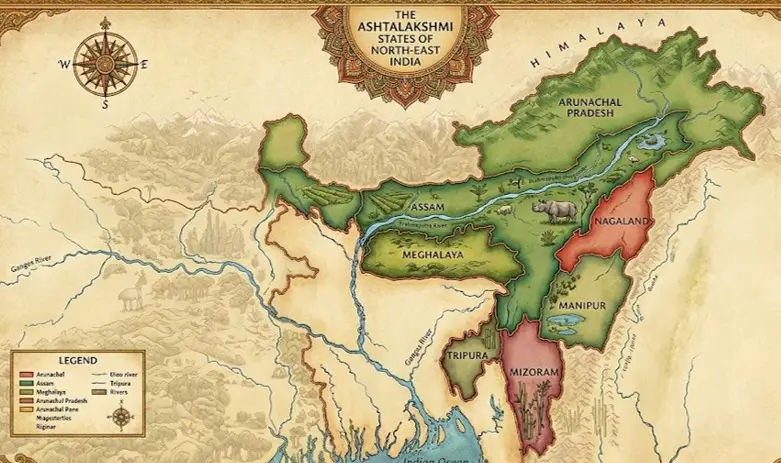
The Ashtalakshmi Growth Model is a development vision for India’s North-East based on the idea that the eight states together represent eight forms of national prosperity.
The eight states are:
Assam
Arunachal Pradesh
Manipur
Meghalaya
Mizoram
Nagaland
Tripura
Sikkim
The model links regional development with national priorities such as:
Infrastructure-led growth
Act East Policy
Border-area development
Clean energy transition
Tourism and cultural economy
Tribal welfare
Internal security
Regional trade and connectivity
Why is the North-East Important for India?
The North-East is strategically located between India and Southeast Asia. It shares international borders with countries such as China, Myanmar, Bangladesh, Bhutan and Nepal. This makes the region important for both national security and foreign policy.
For UPSC, the North-East must be studied not only as a regional-development issue but also as a combined topic of governance, internal security, economy, environment and international relations.
Key Pillars of the Ashtalakshmi Growth Model
1. Connectivity as Development
Historically, the North-East faced geographic isolation due to difficult terrain, weak transport links and limited market access. The current growth model focuses on road, rail, air and digital connectivity.
Better connectivity helps in:
Reducing regional isolation
Improving market access for farmers and artisans
Promoting tourism
Strengthening border management
Supporting disaster response
Improving delivery of welfare schemes
2. Act East to Act Fast
The North-East is central to India’s Act East Policy, which aims to strengthen India’s economic and strategic engagement with Southeast Asia.
The region can become a bridge between India and ASEAN through:
Cross-border road networks
Trade corridors
Border haats
Energy cooperation
Tourism circuits
Cultural diplomacy
This makes the North-East important for India’s Indo-Pacific strategy as well.
3. Clean Energy Potential
The North-East has significant hydropower, gas and renewable energy potential. Development of energy infrastructure in the region can support India’s energy security and clean-energy transition.
However, hydropower projects must be balanced with ecological concerns, tribal rights, seismic risks and biodiversity protection.
4. Social Sector Development
The model also focuses on improvement in basic quality of life through:
Drinking water access
Sanitation
Housing
Healthcare
Education
Skill development
Digital inclusion
This is important for inclusive governance and reducing regional inequality.
5. Cultural and Economic Identity
The North-East has rich cultural diversity, tribal traditions, handlooms, handicrafts, organic products and GI-tagged products. The Ashtalakshmi approach tries to convert this cultural wealth into economic opportunity.
Sectors with high potential include:
Eco-tourism
Handloom and handicrafts
Bamboo industry
Organic farming
Horticulture
Food processing
Adventure tourism
Wellness tourism
Quick Revision
Ashtalakshmi = eight North-Eastern states
Linked to Act East Policy
Focus areas: connectivity, social sector, clean energy, trade, tourism, culture
UPSC relevance: GS2 governance, GS3 infrastructure/security/environment
Key challenge: balancing development, ecology and tribal rights