Tag
#Article 19

Children’s Right to Internet Access: Supreme Court of India
The Supreme Court held that children have a fundamental right to Internet access under Articles 21 and 19(1)(a), subject to reasonable restrictions. It rejected blanket bans as disproportionate, emphasising parental supervision, child-friendly safety features, platform accountability, digital literacy and effective reporting mechanisms to balance children’s online safety with freedom and participation.

Gandhi’s 1922 Court Statement and Delhi Protester Detentions
Gandhi’s remarks in 1922 remain valid in a democratic set-up where the need to challenge peacefully the powers that be is essential. In a democratic set-up, there is a need for the State to preserve law and order without trampling on fundamental rights. The protection of peaceful protest, legal enforcement, and prevention of arbitrary arrest are important constitutional values.
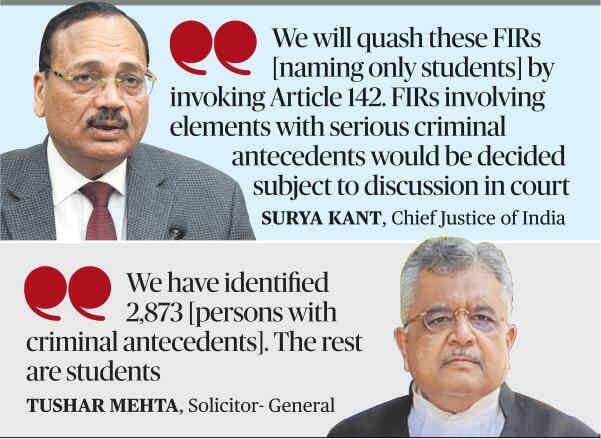
SC to quash FIRs against student protesters
Supreme Court can look into utilising Article 142 for quashing FIRs made against students for their non-violent protests on account of the anomalies associated with NEET-UG. This case has serious implications in terms of differentiating between a non-violent protest and crime, and the conflict between Article 19 rights and maintenance of public order.
Right to Protest in India: Police Permission and Law
The police action against the 20 July 2026 march to Parliament has revived the oldest question in Indian public law: can a fundamental right require a permission slip? Complete UPSC analysis of Article 19(1)(b), Section 163 BNSS, the Police Act 1861 and the landmark judgments from Himat Lal to Shaheen Bagh.