Background
The Southwest Monsoon is India’s principal rainy season, generally extending from June to September and accounting for a major share of the country’s annual rainfall.
Monsoon performance is measured against the Long Period Average (LPA), which is the long-term average rainfall over a reference period.
El Niño, characterised by abnormal warming of the central and eastern tropical Pacific Ocean, can influence atmospheric circulation and generally tends to weaken the Indian summer monsoon.
The IMD had anticipated below-normal rainfall in 2026:
April forecast: 92% of LPA ± 5%.
May update: 90% of LPA ± 4%.
Actual: 87% of LPA.
Feature
Indicator | 2026 |
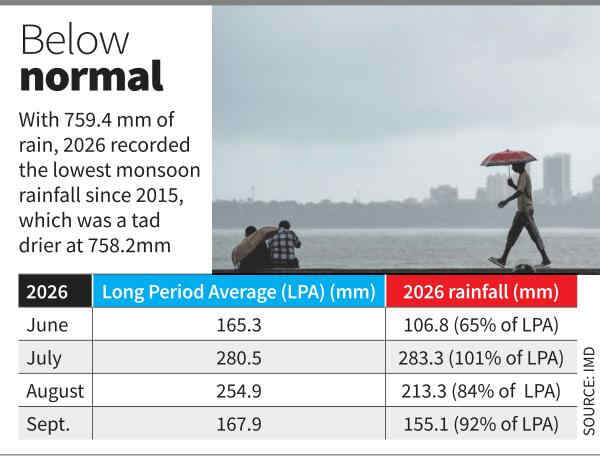
Total rainfall | 759.4 mm |
LPA | 868.6 mm |
Deficit | 12.6% |
Rainfall as % of LPA | 87% |
Lowest since | 2015 |
East & Northeast deficit | 25.6% |
Southern Peninsula deficit | 24.3% |
Monthly Performance
June: 65% of normal — substantially below the forecast of 92%.
July: About 1% above normal, aided by 33% excess rainfall in Central India.
August: 84% of LPA — below normal.
September: 92.4% of LPA — slightly above the forecast of below 91%.
Challenges
Regional rainfall imbalance
The overall national deficit masks significant regional differences. The East and Northeast, and the Southern Peninsula experienced substantial deficits, potentially affecting agriculture, water availability and ecosystems.
Agricultural stress
A deficient monsoon can affect: rain-fed agriculture, Kharif crop yields, soil moisture, reservoir recharge, rural incomes
The impact, however, depends on the timing and spatial distribution of rainfall, not merely the seasonal aggregate.
Strengthening El Niño
A strong El Niño can alter atmospheric circulation and suppress favourable monsoon conditions over India, making seasonal rainfall more uncertain.
Changing rainfall patterns
The IMD noted a marked trend of diminishing rainfall in the East and Northeast in recent years. This raises concerns about long-term changes in regional rainfall distribution.
Forecasting challenges
Although the seasonal forecast broadly anticipated a weak monsoon, June rainfall was significantly drier than forecast, while July performed better than expected. This demonstrates the difficulty of predicting monthly and regional rainfall variability.
Way Forward
Strengthen regional forecasting: Improve district-level and sub-seasonal monsoon forecasts.
Expand irrigation: Reduce dependence on rainfall through micro-irrigation and efficient water management.
Promote climate-resilient agriculture: Encourage drought-tolerant and short-duration crop varieties.
Improve water storage: Strengthen watershed development, groundwater recharge and reservoir management.
Develop regional adaptation strategies: Particularly for the East and Northeast, where persistent rainfall deficits could have structural implications.
Use climate and weather data: Integrate IMD forecasts with agricultural advisories for farmers.
Improve disaster preparedness: Prepare simultaneously for both rainfall deficits and episodes of extreme rainfall, as a deficient seasonal total does not rule out intense short-duration rainfall events.
Conclusion
The southwest monsoon of 2026 reflects the reality that India’s rainfall problem has increasingly become a matter of quantity and distribution. Even though the national-level deficit of 12.6% remained in line with the expectations of the IMD, large variations between regions and months call for the improvement of forecasting, water management and drought-resistant crops. The increasing importance of El Niño and shifting rainfall patterns make monsoon management critical for India.