Background
India and the US have steadily expanded cooperation in civil space activities.
India signed the Artemis Accords in 2023, becoming the 27th signatory.
The partnership includes the NISAR mission, human-spaceflight cooperation and scientific data sharing.
India has set an ambition of achieving a crewed Moon landing by 2040.
The cooperation complements India’s Gaganyaan and Chandrayaan programmes.
What is the Moon Base Programme?
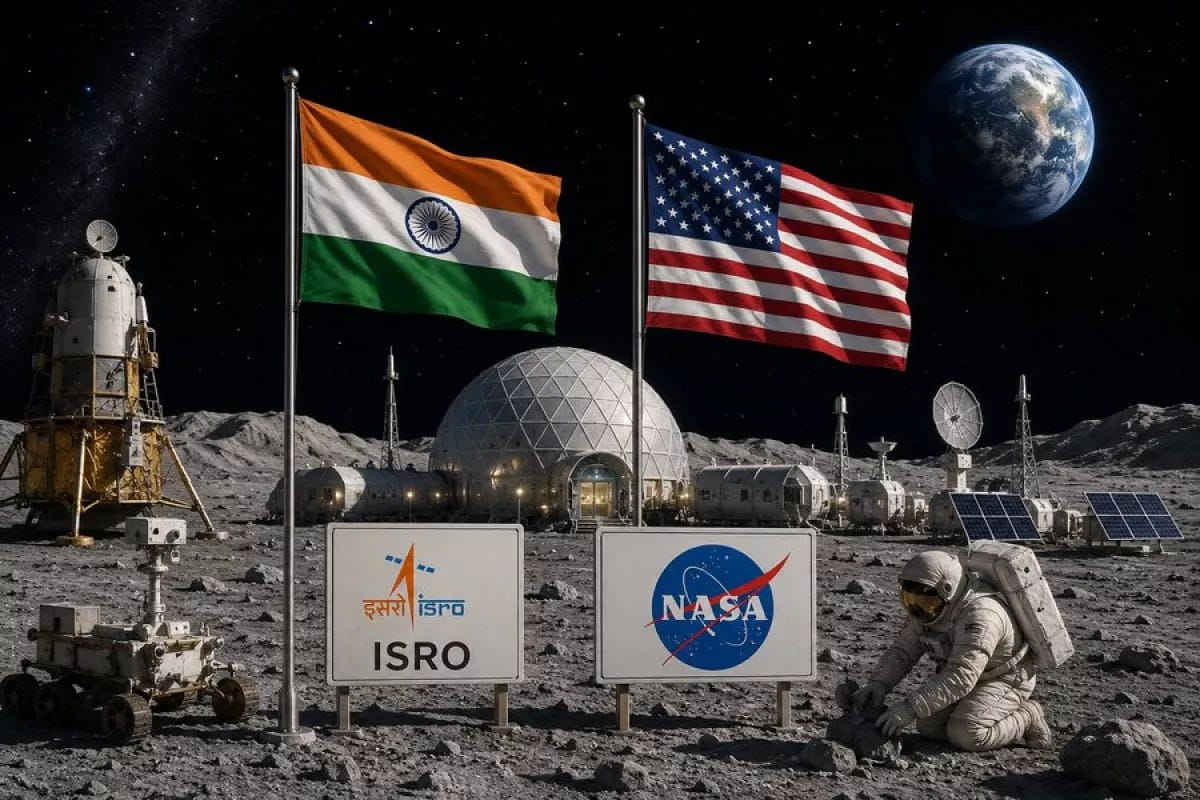
The programme seeks to establish humanity’s first outpost on another celestial body near the lunar South Pole.
The lunar South Pole is significant because of the presence of water ice in permanently shadowed regions.
Water resources could potentially support:
Life-support systems
Drinking water
Production of hydrogen and oxygen
Future rocket propellant
A lunar outpost would also serve as a platform for scientific research, technology demonstration and future deep-space exploration.
What are the Artemis Accords?
The Artemis Accords are a set of non-binding principles led by the United States.
They seek to promote the peaceful, sustainable and transparent exploration and use of outer space, including the Moon.
India became a signatory in 2023.
Key principles include:
Peaceful exploration
Transparency
Interoperability
Emergency assistance to astronauts
Registration of space objects
Release of scientific data
Preservation of space heritage
Sustainable use of space resources
Deepening India–US Space Cooperation
NISAR Mission
NISAR = NASA–ISRO Synthetic Aperture Radar.
It is a joint Earth-observation mission.
Uses dual-frequency Synthetic Aperture Radar.
Monitors:
Land-surface changes
Ice sheets
Ecosystems
Natural hazards
Human Spaceflight
An Indian astronaut travelled to the International Space Station in 2025 through an Axiom mission.
This strengthened cooperation in human spaceflight.
Scientific Data Sharing
Both countries are working towards greater open scientific data sharing.
They have also discussed future missions to the Moon and beyond.
Space Sustainability
India and the US reaffirmed their commitment to UN guidelines on the long-term sustainability of outer-space activities.
This is important for addressing:
Space debris
Orbital congestion
Safe space operations
Sustainable use of outer space
India’s Lunar and Human Spaceflight Programmes
Gaganyaan
India’s human spaceflight programme.
Aims to demonstrate indigenous capability to send Indian astronauts to Low Earth Orbit (LEO).
Chandrayaan Programme
India’s series of lunar exploration missions.
Chandrayaan-3 demonstrated a successful soft landing in the lunar south-polar region.
2040 Moon Landing Goal
India has articulated an ambition for a human Moon landing by 2040.
IN-SPACe
Promotes and facilitates participation of non-government/private entities in India’s space sector.
Indian Space Policy 2023
Provides the policy framework for greater participation of non-government entities in space activities.
Significance for India
Technological advancement: Access to advanced technologies and expertise in lunar exploration.
Human spaceflight: Can complement the experience gained through Gaganyaan.
Strategic partnership: Deepens India–US cooperation in high-end strategic technologies.
Scientific benefits: Greater access to international scientific collaboration and data.
Private-sector opportunity: Indian space startups can participate in emerging lunar activities.
Global space governance: Gives India a greater role in shaping norms for sustainable lunar exploration.
2040 ambition: Supports India’s long-term objective of a human Moon landing.
Challenges
Extreme lunar conditions – radiation, temperature fluctuations, difficult terrain and long periods of darkness.
High cost – Establishing and maintaining a lunar settlement requires enormous financial resources.
Life-support systems – Long-duration human habitation requires reliable air, water, food and waste-management systems.
Energy requirements – Continuous power supply near the lunar South Pole is technically challenging.
Resource governance – Extraction and utilisation of lunar resources raise questions under international space law.
Space sustainability – Growing lunar activity must avoid debris, contamination and damage to scientifically significant sites.
Strategic autonomy – India must balance deeper cooperation with its independent strategic and technological interests.
Way Forward
Strengthen NASA–ISRO joint research and technology development.
Develop indigenous capabilities in:
Lunar habitats
Robotics
Life-support systems
Radiation shielding
Lunar resource utilisation
Encourage greater participation of Indian private space companies.
Expand open scientific data sharing.
Develop internationally accepted norms for responsible lunar resource utilisation.
Ensure lunar exploration conforms with the Outer Space Treaty and UN sustainability principles.
Use international partnerships to accelerate India’s Gaganyaan and 2040 human Moon-landing objectives while maintaining strategic autonomy.
Conclusion
The initiative from NASA to engage ISRO reflects a major shift from collaborative missions to human exploration of the Moon. Getting involved in the lunar outpost program will fast-track the development of space capabilities in India, enhance its standing in space governance, and help achieve the country’s objective of landing humans on the Moon. However, India needs to ensure that the collaboration is peaceful and scientific.