What is Population Enumeration?
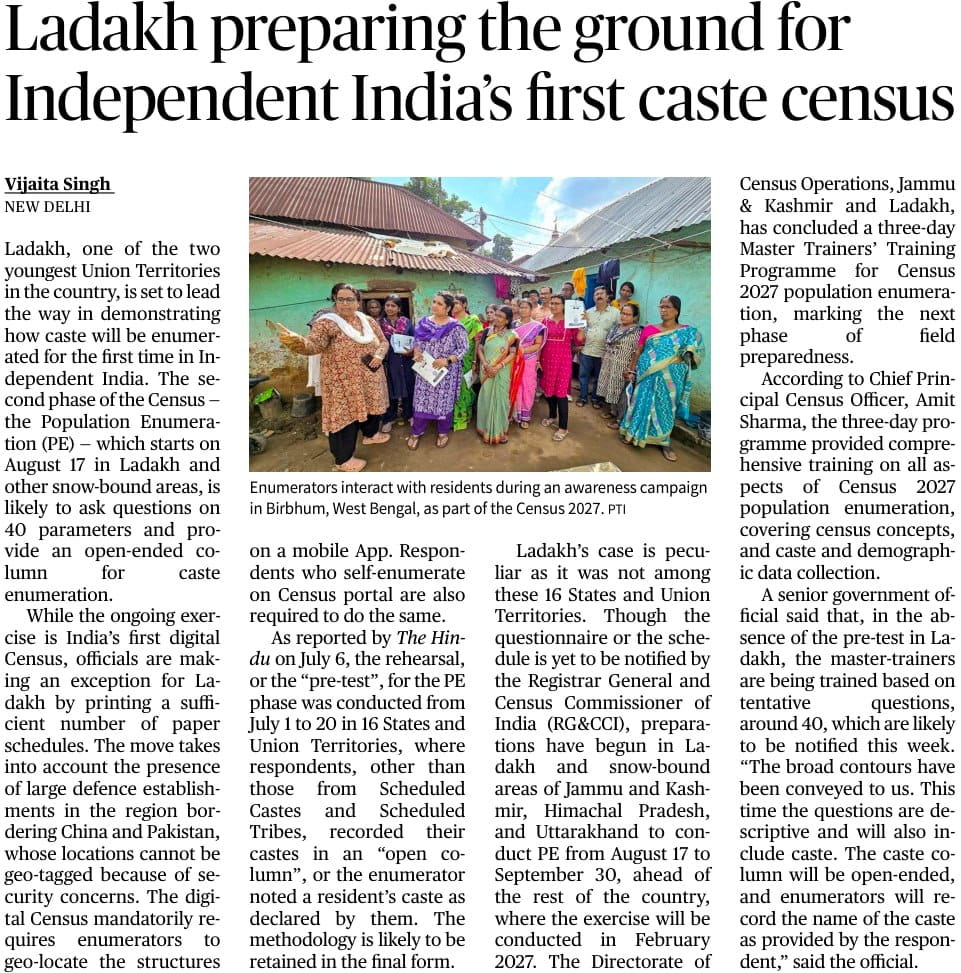
Definition: Population Enumeration is the second phase of the Census, during which detailed demographic information about individuals is collected, including caste-related information.
First phase: It follows Houselisting and Housing Census, which collects information on houses, households and housing amenities.
Census 2027: It will be India's first digital Census, though paper schedules will be used in certain strategically sensitive areas.
Background
After Independence, India's regular Census did not enumerate caste across the entire population; caste data was generally collected for Scheduled Castes (SCs) and Scheduled Tribes (STs).
The 1931 Census remains the last comprehensive colonial-era Census commonly used as the benchmark for all-India caste data.
The Socio-Economic and Caste Census (SECC), 2011 collected caste-related information, but it was a separate exercise from the regular Census, and its caste data was not released as a comprehensive official caste database.
For Census 2027, a pre-test of Population Enumeration was conducted in 16 States/UTs from July 1–20, 2026.
In the pre-test, respondents other than SCs and STs reported their caste through an open-ended field.
Ladakh was not included in the pre-test, so officials are being trained using tentative questions and procedures.
Why Does Caste Enumeration Matter?
Policy base: Reliable caste data can strengthen evidence-based policymaking concerning reservation, welfare targeting, affirmative action and sub-categorisation. Earlier nationwide caste data often cited for policy purposes dates to the 1931 Census.
Open-ended column: Instead of restricting respondents to a predetermined list, the caste field is expected to allow self-declaration, with enumerators recording the caste name provided by respondents.
Classification challenge: India's enormous diversity of castes, sub-castes, regional names and synonyms can create challenges in standardisation, coding and comparability.
Strategic geography: Ladakh's location near the China and Pakistan borders creates special logistical and security requirements. Defence establishments cannot necessarily be geo-tagged, necessitating the use of paper schedules as an exception to the digital process.
Challenges
Classification: Thousands of caste and sub-caste identities, regional names and synonyms can complicate standardisation.
Self-identification: Open-ended responses may create problems of consistency and comparability.
Data privacy: Caste information is socially sensitive and requires strong confidentiality safeguards.
Digital challenges: Remote and mountainous regions may face connectivity and infrastructure constraints.
Security concerns: Defence establishments in Ladakh cannot be geo-tagged in the normal manner.
Data interpretation: Caste data can have significant political and social implications, making methodology and subsequent publication highly sensitive.
Way Forward
Develop a transparent and standardised coding methodology while preserving self-identification.
Train enumerators to record caste without imposing or altering the respondent's declaration.
Establish strong data protection and confidentiality mechanisms.
Use a hybrid digital + paper approach wherever security, geography or connectivity requires it.
Conduct quality checks and post-enumeration verification to minimise errors.
Use the final data primarily for evidence-based social justice, welfare and development policy.
Conclusion
The enumeration of caste within Census 2027 is an important milestone in the framework of demographic data in India. Its importance would be determined by the accuracy of the counting and proper classification, as well as by its confidentiality and methodology.