Tag
#Climate Change

Why Strong El Niño Does Not Guarantee a Poor Indian Monsoon
A strong El Niño can weaken the Indian monsoon, but it does not always lead to deficient rainfall. Other factors, such as the Indian Ocean Dipole, ocean temperatures and monsoon circulation, can influence rainfall patterns and offset its effects.

India’s next investment cycle will shape its carbon future
India’s next investment cycle offers an opportunity to pursue economic growth alongside decarbonisation. With most future buildings yet to be constructed, India must enforce energy-efficient standards, expand renewable-energy transmission and storage, promote green steel and cement through public procurement, and improve green finance.
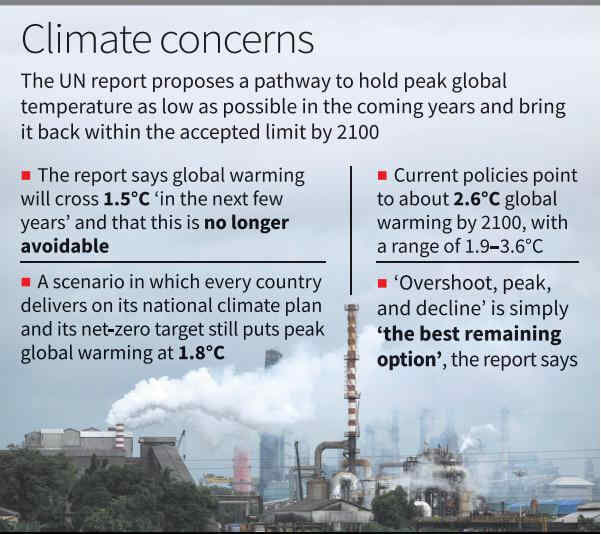
UN sets pathway to tackle ‘inevitable breach’ of the 1.5°C global warming limit
UNEP states that a breach beyond 1.5 degrees Celsius is inevitable and suggests "overshoot, peak and decline" by making deep reductions in greenhouse gas emissions and carbon dioxide removal. Issues faced: tipping points, uncertainty about carbon dioxide removal, climate justice, and complacency. Path forward: shift from fossil fuels, reduce methane, adapt, and climate finance.

Why Floods in Kerala Are Becoming More Severe
Floods in Kerala are becoming increasingly intense as a result of the monsoonal rains and human actions like wetland destruction, siltation of rivers, siltation of dams, and urbanization. It is crucial that steps like wetland restoration, desiltation of rivers, regulation of land use, development of climate-proof infrastructure, and river basin management are undertaken to prevent floods.

When is Heavy Rainfall a Cloudburst, and When is It Not?
A cloudburst, according to the IMD, is a sudden heavy rainfall of 100 mm or more occurring within an hour in an area of 20 to 30 sq. km. Such phenomena are very common in the Himalayan region, which leads to flash floods and landslides.