DailyGS3medium

India’s First Privately-Built FFSC Rocket Engine Signals New Dawn

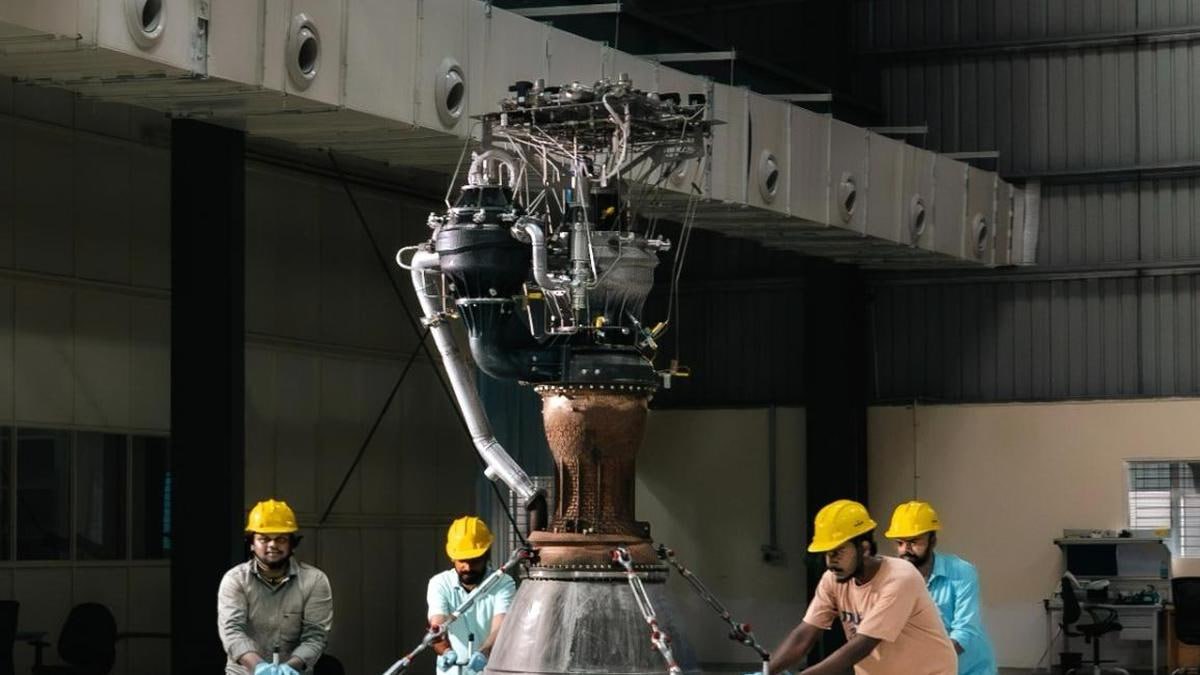
India’s first-ever private EVEREST FFSC LOX-methane engine is a big step forward for the Indian private sector in space propulsion. The engine provides high efficiency and reusability due to its 800 kN thrust. This new development of India, with help from IN-SPACe and the India Space Policy 2023, can be useful in increasing indigenous propulsion, heavy lift, and reusability capability.

11 Aug 2026 3 min read 3 views
India’s First Privately-Built FFSC Rocket Engine Signals New Dawn

Quick Revision

Why in news: India's first-ever privately developed Full Flow Staged Combustion (FFSC) LOX-Methane engine called EVEREST was launched by Bengaluru-based Astrobase Space Technologies on 7 August 2026. With this, India has become the fourth nation to develop FFSC technology after Russia, the USA, and China.

Background

  • FFSC (Full-Flow Staged Combustion) is an advanced rocket-engine cycle in which both propellants pass through separate pre-burners before driving the turbopumps and entering the main combustion chamber.

  • It allows almost all of the propellant to contribute to thrust, resulting in high efficiency, high chamber pressure, and improved reusability.

  • EVEREST uses LOX (Liquid Oxygen) as oxidiser and methane as fuel.

  • Methane burns relatively cleanly, reducing carbon deposits and potentially enabling faster refurbishment and turnaround.

  • India’s private space sector expanded significantly after the 2020 space-sector reforms and the establishment of IN-SPACe.

  • The Indian Space Policy 2023 further enabled private companies to participate across the space value chain.

Role of IN-SPACe

  • IN-SPACe - Indian National Space Promotion and Authorisation Centre - is an autonomous agency under the Department of Space.

  • It functions as a single-window mechanism for promoting, facilitating and authorising private-sector space activities.

  • Its Technology Adoption Fund supports adoption and development of advanced space technologies by Indian private entities.

Features 

  • 800 kN thrust: Represents a major step towards high-thrust propulsion capability by India’s private space sector.

  • FFSC technology: Places India among only four countries with demonstrated FFSC development capability.

  • Reusable launch vehicles: High efficiency and precise throttling make FFSC engines suitable for reusable systems.

  • Heavy-lift potential: The technology could support reusable launch systems capable of carrying up to 30 tonnes to LEO.

  • Advanced manufacturing: Extensive use of 3D printing/additive manufacturing can reduce production complexity and development time.

  • Strategic autonomy: Indigenous propulsion technology can reduce dependence on foreign launch-engine technologies.

  • Private-sector innovation: Demonstrates the growing role of Indian start-ups in developing advanced space hardware.

Challenges

  • Technological complexity: FFSC engines involve extremely high pressures, temperatures and demanding turbomachinery requirements.

  • Testing and reliability: Repeated hot-fire tests are essential before the engine can be qualified for flight.

  • Reusability: Designing an engine for multiple flights requires high durability and rapid turnaround without compromising safety.

  • Manufacturing scale-up: Moving from prototypes to serial production requires sophisticated supply chains and quality-control systems.

  • Capital intensity: Large launch engines require substantial long-term investment.

  • Global competition: Indian firms face established players with extensive experience in reusable propulsion.

  • Regulatory and infrastructure requirements: Advanced testing facilities, certification and launch infrastructure need to grow alongside private-sector capability.

Way Forward

  • Strengthen public-private partnerships for propulsion research, testing and infrastructure.

  • Expand IN-SPACe funding and technology-transfer mechanisms for critical technologies.

  • Develop domestic supply chains for turbopumps, valves, sensors, combustion chambers and advanced materials.

  • Establish more high-capacity engine test facilities accessible to private companies.

  • Promote additive manufacturing and indigenous materials for faster and cheaper production.

  • Encourage collaboration between ISRO, start-ups, academia and industry.

  • Focus on reusable launch vehicles and rapid turnaround, enabling India to compete in the global commercial launch market.

Conclusion

The EVEREST FFSC LOX-Methane Engine marks a major shift in India’s space program from public sector-driven propulsion innovation to cutting-edge private sector innovation. The success of this engine will help build India’s capabilities in reusable launchers, heavy-lift launches, and space transport. Continued research, development, and cooperation among ISRO, IN-SPACe, and the private sector will be essential in turning this technological breakthrough into a launch capability.

UPSC Prelims Facts

Term: Full-Flow Staged Combustion (FFSC)

Meaning: Full-Flow Staged Combustion (FFSC) is an advanced rocket-engine cycle in which both the fuel-rich and oxidiser-rich propellant streams pass through separate pre-burners before driving their respective turbopumps and entering the main combustion chamber. It enables high chamber pressure, high efficiency, improved propellant utilisation and potential reusability.

Related: FFSC Engine; EVEREST Engine; LOX-Methane Propulsion; Liquid Oxygen (LOX); Methane; Pre-burner; Turbopump; Staged Combustion Cycle; Rocket Propulsion; Reusable Launch Vehicle (RLV); Heavy-Lift Launch Vehicle; Additive Manufacturing; 3D Printing; IN-SPACe; Indian Space Policy 2023; Private Space Sector; ISRO; Commercial Spaceflight; Low Earth Orbit (LEO); Strategic Autonomy; Public-Private Partnership.

Core Themes: Advanced Propulsion Technology; Reusable Spaceflight; Private-Sector Innovation; Space Commercialisation; Strategic Autonomy; Indigenous Technology; Heavy-Lift Capability; Clean Propellants; Additive Manufacturing; High-Thrust Propulsion; Technology Demonstration; Public-Private Collaboration; Space Transportation; Global Competitiveness.

Prelims angle

Focus on key facts, terms and institutions mentioned above.

Mains angle

Link to relevant GS themes and frame analytical points.

Syllabus: Science & Technology, Space Technology

Download notes

Daily Current Affairs - 11 August 2026

Free download

Test yourself

Daily Current Affairs Quiz : 11 August 2026

Practice the related MCQs now.

Attempt the quiz
Free resource

Get free monthly Current Affairs PDF

Join thousands of aspirants. We'll send the compilation to your WhatsApp.

No spam. Unsubscribe anytime.

More from Current Affairs

New Real-Time Portal for Organ Transplants Launched
Daily Important
Science & TechPrelims + Mains

New Real-Time Portal for Organ Transplants Launched

The NOTTO Real-Time Organ Transplantation portal brings forth a consolidated national wait list, facilitates real-time organ distribution, helps to facilitate national donation swaps, and enhances the transparency and effectiveness of transplantations. The tool promotes Digital Health governance but needs higher organ donor rates, participation of states on an equal footing, advanced hospital infrastructure, and public education to succeed.

4 Aug 2026 3 min
The next DPI — how India can commoditise AI
Daily Important
Science & TechPrelims + Mains

The next DPI — how India can commoditise AI

India has proposed an expansion of the successful DPI concept into Artificial Intelligence through the establishment of low-cost AI computing, foundation models, and a Unified Intelligence Interface (UII). AI can become an easily available public utility through the IndiaAI Mission and contribute to innovation, technological sovereignty, and inclusive development.

31 Jul 2026 3 min
BS-III Vehicles May Need Modifications for E20 Fuel: Government
Daily Important
Science & TechPrelims + Mains

BS-III Vehicles May Need Modifications for E20 Fuel: Government

E20 is a fuel consisting of 20 per cent ethanol and 80 per cent petrol; it is available through India’s Ethanol Blended Petrol programme to reduce the country’s reliance on imported crude oil, mitigate pollution, and boost renewable energy production. It can be used in BS-IV, BS-VI and E20-compatible vehicles, but older BS-III vehicles need some rubber parts replaced.

30 Jul 2026 2 min